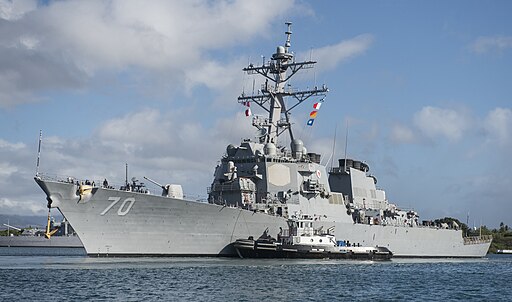
USS Hopper (DDG-70)
USS Hopper (DDG‑70) is an advanced Arleigh Burke‑class guided missile destroyer that stands at the forefront of U.S. Navy technology and operational capability. Named in honor of Rear Admiral Grace Hopper—a pioneer in computer science and a trailblazer in naval innovation—this vessel represents the fusion of legacy and modern warfare. The ship combines state‑of‑the‑art combat systems, exceptional mobility, and formidable armaments to ensure maritime security and provide multi‑domain operational flexibility.
Historical Background and Legacy
USS Hopper (DDG‑70) carries a proud heritage as one of the Arleigh Burke‑class destroyers, a family of ships renowned for their robust design, versatility, and advanced technological integration. Commissioned to honor the remarkable contributions of Grace Hopper, the vessel embodies the spirit of innovation and service that revolutionized computing and naval operations alike. Since entering service, USS Hopper has participated in numerous exercises and deployments, demonstrating its ability to operate seamlessly across a variety of mission sets—from anti‑air warfare and missile defense to surface warfare and maritime interdiction.
Design Philosophy and Operational Role
The design of USS Hopper reflects a commitment to survivability, rapid response, and multi‑role functionality. The ship’s hull, constructed with durability in mind, is engineered to withstand the harsh conditions of open ocean operations while maintaining excellent maneuverability. Its integrated combat systems, centered on the Aegis Combat System, provide real‑time situational awareness and precise engagement capabilities against a broad spectrum of threats. Whether it is safeguarding allied forces, deterring adversary missile attacks, or launching precision strikes, USS Hopper is designed to operate in contested and congested maritime environments.
Technical Specifications
Displacement and Dimensions
- Full‑load Displacement: Approximately 9,200 tons
- Length: About 510 feet (155 meters)
- Beam: Nearly 66 feet (20 meters)
- Draft: Roughly 32 feet (9.8 meters)
These dimensions provide a balance between the vessel’s operational range, stability, and speed, allowing it to perform effectively in a variety of maritime settings.
Propulsion and Performance
USS Hopper is propelled by a Combined Gas and Gas (COGAG) system, featuring four General Electric LM2500 gas turbines. This power plant configuration enables the destroyer to achieve speeds exceeding 30 knots while maintaining high operational efficiency. The propulsion system is designed for rapid acceleration and agile maneuvering, essential for evading threats and maintaining tactical positioning during combat operations.
Endurance and Range
With a significant fuel capacity and optimized engineering, USS Hopper can sustain extended deployments with a global reach. Its endurance is enhanced by advanced logistical support systems, allowing the ship to operate effectively over long distances without compromising combat readiness.
Combat Systems and Sensors
Aegis Combat System
At the heart of USS Hopper’s operational prowess is the Aegis Combat System, an integrated suite of sensors, weapons, and command‑and‑control capabilities. The system’s SPY‑1D radar provides comprehensive surveillance and tracking of airborne, surface, and subsurface targets. This powerful radar is capable of simultaneously engaging multiple threats, making it a critical component in missile defense and air superiority operations.
Command and Control
The ship’s advanced command and control systems process vast amounts of data in real time, enabling the crew to make informed tactical decisions rapidly. Networked communications and integration with allied forces ensure that USS Hopper can operate as a key node within a larger battle group, contributing to coordinated multi‑domain operations.
Armament and Missile Systems
Vertical Launch System (VLS)
One of USS Hopper’s most formidable features is its Vertical Launch System, which can house a variety of missile types. The VLS is capable of launching Standard Missiles (SM‑2/SM‑3/SM‑6) for air defense and ballistic missile defense, Tomahawk Land Attack Missiles (TLAM) for precision strike capabilities, and ASROC (Anti‑Submarine Rocket) for counter‑submarine warfare. This flexibility ensures that the destroyer can adapt its offensive and defensive posture to meet evolving threat scenarios.
Naval Gun and Close‑In Weapon Systems
Complementing its missile systems, USS Hopper is equipped with a 5‑inch (127 mm) naval gun for surface engagements and shore bombardment. Additionally, the ship features a Phalanx Close‑In Weapon System (CIWS) that provides rapid, last‑line defense against incoming missiles and aircraft. These systems work together to create multiple layers of defense, ensuring the ship’s survivability in a high-threat environment.
Integrated Electronic Warfare and Countermeasures
USS Hopper is outfitted with a suite of electronic warfare systems that serve to detect, disrupt, and neutralize enemy sensors and communications. Advanced decoy systems, jammers, and radar warning receivers work in concert to confuse hostile targeting systems and reduce the probability of successful enemy engagements. These countermeasures are vital for maintaining the destroyer’s operational security in contested environments.
Crew and Mission Systems
The ship is operated by a highly trained crew that benefits from modern automation and ergonomic design. Crew stations are optimized for efficiency, with integrated displays and control systems that streamline operations during complex missions. Training simulators and advanced communication networks ensure that the crew is always prepared to respond to evolving tactical situations, enhancing the overall combat effectiveness of USS Hopper.
Operational Impact and Future Prospects
Since its commissioning, USS Hopper (DDG‑70) has played a critical role in demonstrating U.S. naval power and commitment to maritime security. Its blend of speed, firepower, and sophisticated combat systems makes it a pivotal asset in modern naval strategy. As threats evolve and technology advances, ships like USS Hopper continue to be upgraded and modernized, ensuring that they remain at the cutting edge of naval warfare.
In summary, USS Hopper (DDG‑70) is more than just a destroyer—it is a dynamic platform that embodies the synthesis of advanced engineering, tactical versatility, and historical legacy. Its robust design, coupled with a suite of state‑of‑the‑art systems, positions it as a key player in maintaining freedom of navigation and supporting global maritime security in an increasingly complex world.
_departs_Pearl_Harbor_160520-N-GO855-405.jpg)