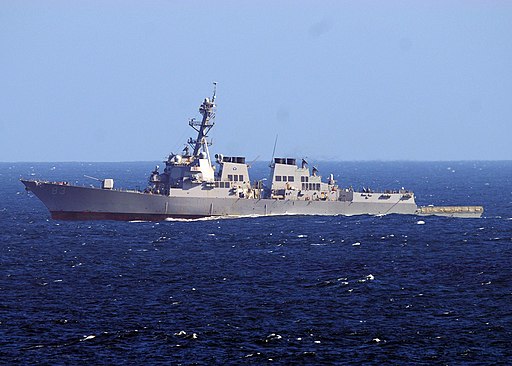
USS Howard (DDG-83)
USS Howard (DDG‑83) stands as a testament to modern naval engineering and tactical versatility. As an Arleigh Burke‑class guided missile destroyer, she embodies decades of evolution in design, armament, and systems integration. Named in honor of individuals who have demonstrated valor and excellence in naval service, USS Howard is a multi‑role platform designed to execute a broad spectrum of missions—ranging from air defense and missile protection to surface warfare and strike operations.
Historical Context and Mission Evolution
Commissioned as part of the continual effort to maintain U.S. maritime superiority, USS Howard was built to operate in increasingly complex and contested environments. The ship’s development reflects lessons learned from past conflicts, integrating cutting‑edge technology with proven design principles. Since her commissioning, USS Howard has participated in numerous training exercises, joint operations, and real‑world deployments, ensuring that she is always prepared to protect national interests and support allies across the globe.
Design Philosophy and Operational Capabilities
At the core of USS Howard’s design is the balance between offensive firepower, defensive resilience, and operational flexibility. The ship’s structure is optimized for survivability in a high‑threat environment. A combination of stealthy hull shaping, redundant systems, and layered defensive measures allow her to operate safely in areas where threats from anti‑ship missiles, aircraft, and submarines are ever‑present.
Her role as a key element in carrier strike groups and independent deployments underscores the importance of multi‑domain integration. USS Howard’s sensor suite, command and control systems, and weapons platforms work in harmony to provide comprehensive situational awareness and rapid decision‑making capabilities.
Technical Specifications
Displacement and Dimensions
- Full‑Load Displacement: Approximately 9,200 tons
- Length: About 505 feet (154 meters)
- Beam: Roughly 66 feet (20 meters)
- Draft: Approximately 32 feet (9.8 meters)
These dimensions offer a balance between agility and endurance. The hull is designed not only for high‑speed maneuverability but also for long‑duration deployments in varied sea states.
Propulsion and Performance
USS Howard is powered by a Combined Gas and Gas (COGAG) propulsion system. This configuration consists of four General Electric LM2500 gas turbines working in concert to deliver:
- Speed: In excess of 30 knots
- Acceleration: Capable of rapid speed changes essential for tactical maneuvers
- Efficiency: Optimized for both high‑speed sprinting and long‑range cruising
The propulsion system’s design supports the ship’s need for quick repositioning during dynamic operational scenarios while maintaining fuel efficiency during extended deployments.
Combat Systems and Sensors
At the heart of USS Howard’s operational capability is the advanced Aegis Combat System. This integrated suite is central to her ability to detect, track, and engage multiple threats simultaneously.
- Radar Systems: The SPY‑1D(V) radar provides 360‑degree coverage with high‑resolution tracking of airborne, surface, and subsurface targets. This radar’s advanced capabilities are critical for missile defense and situational awareness.
- Command and Control: Network‑centric systems ensure that data from sensors, weapons, and external sources are processed in real time. This integration allows the ship’s crew to coordinate defensive and offensive actions swiftly.
- Electronic Warfare: Advanced countermeasures, including decoys and jamming systems, help to protect the vessel from hostile targeting systems and electronic attacks.
Armament and Missile Defense
USS Howard is equipped with a versatile array of weapons systems designed for both offensive and defensive operations.
- Vertical Launch System (VLS): The ship’s VLS cells can deploy a variety of missile types including Standard Missiles (SM‑2, SM‑3, SM‑6) for air and missile defense, Tomahawk Land Attack Missiles (TLAM) for precision strikes, and ASROC for anti‑submarine warfare.
- Naval Gun: A 5‑inch (127 mm) Mark 45 naval gun provides both surface engagement and shore bombardment capabilities.
- Close‑In Weapon System (CIWS): The Phalanx CIWS offers rapid, automated defense against incoming anti‑ship missiles and other close‑range threats.
- Additional Systems: The ship also incorporates machine guns and other short‑range defensive measures, providing layered protection against various threat vectors.
Crew and Operational Efficiency
USS Howard’s design incorporates state‑of‑the‑art automation and ergonomic workspaces, significantly reducing crew workload during high‑intensity operations. Modern communication systems and advanced decision‑support tools enhance situational awareness and streamline command operations. The crew, trained in the latest tactical doctrines, benefits from systems designed to facilitate efficient operations even under extreme conditions.
Endurance and Sustainment
With a fuel‑efficient propulsion system and robust logistics support, USS Howard is capable of extended deployments across vast ocean theaters. Her endurance is further enhanced by advanced maintenance protocols and modular design features that allow for rapid updates and repairs, ensuring high availability and operational readiness.
Integrated Systems and Future Upgrades
USS Howard is not only a platform of current naval capability but also a testbed for future technological enhancements. Her modular systems design allows for the integration of new technologies such as next‑generation missile systems, upgraded radar and sensor suites, and advanced cyber‑defense measures. As threats evolve, so too will her capabilities—ensuring that she remains a cornerstone of U.S. naval power for decades to come.
Conclusion
USS Howard (DDG‑83) exemplifies the blend of legacy, innovation, and strategic foresight that defines modern U.S. naval warfare. With a robust design tailored for multi‑domain operations, an advanced suite of sensors and weapons, and a propulsion system engineered for speed and endurance, she stands ready to meet the challenges of today’s dynamic maritime environment. As global threats evolve, USS Howard’s ongoing upgrades and state‑of‑the‑art systems ensure that she continues to provide unmatched tactical superiority and operational flexibility, safeguarding freedom and maintaining maritime security around the world.
_transits_the_Pacific_Ocean.jpg)