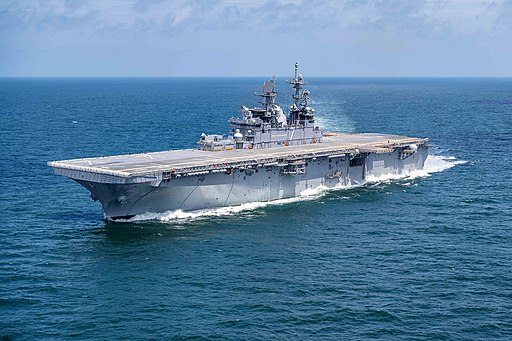
USS Tripoli (LHA-7)
USS Tripoli (LHA-7) is the third ship in the America-class Flight 0 series of amphibious assault vessels. Delivered to the U.S. Navy in July 2020, she embodies a design philosophy that prioritizes aviation power projection, command-and-control flexibility, and long-range expeditionary reach. By omitting the traditional well deck in favor of expanded aviation and maintenance facilities, Tripoli can support a full complement of tilt-rotor MV-22B Ospreys, F-35B Lightning II fighters, and a spectrum of rotary-wing platforms for sustained operations spanning air, land, and sea.
Hull and Structural Design
Hull Form and Materials
Tripoli’s hull is constructed from high-strength naval steel, optimized for both structural integrity and weight savings. The flared bow section deflects wave impact, while the bulbous bow reduces resistance at convoy speeds. Long-span girder framing and transverse bulkheads provide torsional stiffness, enabling the ship to withstand severe sea states and battle damage with minimal hull deformation.
Damage Control and Survivability
A fully automated fire-main system links sensors, pumps, and remote-operated valves to speed firefighting and flooding responses. Compartmentalization ensures that a breach in one watertight zone does not cascade into adjacent spaces. The redundant power distribution network splits electrical loads across separate switchboards, preserving critical systems even if one switchboard is disabled.
Dimensions and Performance
| Characteristic | Specification |
|---|---|
| Displacement (full load) | 45,000 long tons |
| Length overall | 844 ft (257 m) |
| Beam (waterline) | 106 ft (32 m) |
| Draft | 26 ft (7.9 m) |
| Maximum Speed | 22 knots (25 mph; 41 km/h) |
| Range | 9,000 nautical miles at 18 knots |
| Endurance | 30 days with full aviation operations |
Propulsion and Electrical Plant
Main Propulsion
Tripoli employs two LM2500+G4 marine gas turbines, each delivering 35,000 shaft horsepower to its respective reduction gearbox. The twin shafts turn controllable-pitch propellers that balance maneuverability with fuel efficiency. A pair of 5,000 hp auxiliary propulsion motors provide low-speed station keeping and precision control during amphibious operations.
Power Generation and Distribution
Four 4 MW diesel generators supplement the gas turbines by supplying hotel loads, aviation support systems, and mission-critical electronics. An integrated power management system routes power across two main switchboards and an emergency bus, automatically isolating faults and reconfiguring distribution to maintain propulsion and combat system readiness.
Aviation Facilities and Flight Operations
Flight Deck and Hangar
The expansive flight deck spans the full length of the ship’s superstructure, featuring reinforced landing spots for F-35B short-take-off/vertical-landing jets and MV-22B tilt-rotors. An embedded electronic landing aid provides real-time glide-slope and alignment cues to pilots. Below deck, a two-bay hangar equipped with overhead handling cranes and expanded parts storage supports simultaneous maintenance of up to 20 aircraft.
Aviation Fuel and Ordnance Handling
A 500,000-gallon JP-5 fuel storage capacity, paired with automated pumping stations, enables high sortie rates. Ordnance magazines are segregated into multiple temperature-controlled magazines, each fitted with blast containment doors. Weapon spell lockers adjacent to the hangar facilitate rapid re-arming of embarked squadrons.
Command, Control, Communications, Computers, Intelligence (C4I)
Combat Information Center
The Combat Information Center (CIC) serves as Tripoli’s tactical nerve center. Multiple high-resolution consoles display integrated sensor feeds, air-traffic control data, and real-time allied task-force coordination networks. An open-architecture combat management system allows modular software upgrades without major hardware overhauls.
Communications Suite
- SATCOM terminals for global voice and data reach
- Link 16 and Cooperative Engagement Capability (CEC) for secure tactical data exchange
- SHF/UHF line-of-sight radios for ship-to-shore and ship-to-aircraft links
- Tactical fiber-optic backbone interconnecting decks and CIC, with encryption nodes at each station
Self-Defense Systems
Missile Defense
Tripoli carries two Evolved Sea Sparrow Missile (ESSM) launchers for medium-range aerial threats. The AN/SPY-6(V)2 multifunction radar provides simultaneous air and surface search, enabling rapid target handoff to the Mk 41 Vertical Launch System cells.
Close-In Weapon Systems
- Two Mk 15 Phalanx Block 1B CIWS units deliver 20 mm rounds at up to 4,500 rounds per minute against inbound missiles and small craft.
- Rolling Airframe Missile (RAM) launchers on each beam add a passive homing layer of defense.
Electronic Warfare and Decoys
An AN/SLQ-32(V)6 electronic support measures suite detects and classifies hostile emissions. Mk 53 Nulka active decoys can be deployed on both sides to seduce incoming anti-ship missiles.
Amphibious and Marine Support
Well Deck Omissions and Alternatives
Unlike earlier LHAs, Tripoli omits a well deck to maximize aviation capacity. To maintain amphibious maneuver flexibility, she embarks:
- A reinforced detachment of Marine MV-22Bs for over-the-horizon insertion
- CH-53K King Stallions and UH-1Y Venoms for heavy-lift and utility support
- A contingent of embarked Marines trained in vertical-assault tactics
Medical and Casualty Care
A full-service Role 2 embarked medical facility features:
- Surgical suite for trauma interventions
- X-ray and laboratory analysis labs
- Intensive care beds and patient isolation rooms
These capabilities allow Tripoli to act as a forward-deployed casualty treatment platform during amphibious landings or humanitarian missions.
Crew and Accommodations
Ship’s Company
Tripoli’s standard complement includes 102 officers and 1,102 enlisted sailors. Modular berthing compartments make use of fold-away rack systems to optimize personal space. Climate-controlled heating and ventilation circuits maintain stable living conditions even in extreme climates.
Embarked Marines
The flight-deck centric design supports up to 1,687 embarked Marines, plus a 184-person surge detachment. Dedicated troop support areas include:
- Galley with extended-range meal production lines
- Fitness and recreation center with cardio and weight-training equipment
- Mission planning rooms equipped with secured data terminals
Sensor Suite and Navigation
Radar and Sonar
- AN/SPS-48E 3D air-search radar with a 250 mile detection range
- AN/SPS-73(V)18 surface-search radar optimized for small craft tracking
- Hull-mounted sonar for low-frequency threat detection in littoral waters
Navigation and Piloting Aids
An integrated bridge system features:
- Electronic chart display and information system (ECDIS)
- Voyage data recorder and automated route planning
- Dual-axis inertial navigation units synchronized with GPS
Modernization Pathways
Planned mid-life upgrades include:
- Installation of solid-state C4I electronics to reduce power draw and heat signature
- Integration of directed energy weapons for close-in defense against swarms of drones
- Unmanned aerial and surface vehicle control stations within the CIC for extended ISR reach
Conclusion
USS Tripoli (LHA-7) represents a strategic shift toward aviation-dominant amphibious assault doctrine. Her blend of cutting-edge propulsion, robust self-defense, and unmatched aviation facilities make her a keystone asset for power projection and crisis response. By forgoing a well deck in favor of air-centric capabilities, Tripoli stands ready to deliver Marines and combat airpower with global speed, endurance, and lethality.
_underway_in_the_Gulf_of_Mexico_on_15_July_2019_(190715-O-N0101-115).JPG)