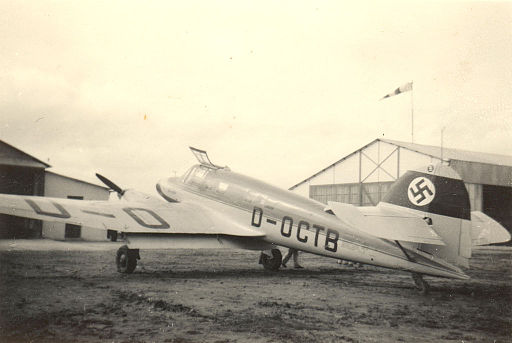
AGO Ao 192
AGO Ao 192 Kurier: Germany’s Forgotten Liaison and Utility Aircraft
The AGO Ao 192 “Kurier” was a German light transport and liaison aircraft developed in the late 1930s by AGO Flugzeugwerke, a firm with deep roots in early German aviation. Though it never saw large-scale production, the Ao 192 represents a unique chapter in the story of pre-World War II military and civil aviation in Germany, designed as a versatile multi-purpose aircraft with potential roles ranging from VIP transport to military courier duties.
This article explores the technical, historical, and design aspects of the AGO Ao 192, examining why this promising aircraft ultimately faded into obscurity.
Historical Context
By the mid-1930s, Nazi Germany was rearming and rebuilding its Luftwaffe, prioritizing advanced fighters and bombers. Nonetheless, there was a growing need for liaison, courier, and light transport aircraft capable of operating in both military and government roles. The success of aircraft like the Fieseler Fi 156 Storch and Messerschmitt Bf 108 Taifun illustrated the importance of fast, versatile light aircraft.
In this climate, AGO Flugzeugwerke (Aktiengesellschaft Otto) developed the Ao 192, intended to fulfill multiple roles within both the Luftwaffe and civilian aviation sector. The aircraft was officially named “Kurier”, meaning “Courier,” reflecting its intended primary role.
Design and Airframe
The AGO Ao 192 was a low-wing twin-engine monoplane, constructed almost entirely of metal, which was relatively modern at the time. It featured a sleek fuselage with a rounded nose and streamlined canopy, offering good visibility and aerodynamic efficiency.
Airframe and Structure
- Configuration: Low-wing monoplane
- Construction: All-metal (duralumin) semi-monocoque fuselage
- Wing: Cantilever low-wing design with slight taper and rounded tips
- Landing gear: Retractable tailwheel undercarriage
- Main gear: Retracted rearward into engine nacelles
- Tailwheel: Non-retractable
The aircraft’s clean lines and retractable gear helped reduce drag, contributing to its relatively high speed and efficient cruise characteristics.
Dimensions
- Length: 10.20 meters (33 ft 6 in)
- Wingspan: 15.80 meters (51 ft 10 in)
- Height: 3.60 meters (11 ft 10 in)
- Wing area: Approximately 34 m² (366 ft²)
These dimensions placed it slightly larger than the Bf 108, making it suitable for more demanding utility roles, including cargo transport and VIP transport.
Cockpit and Cabin Configuration
The cockpit was designed for two pilots seated side-by-side, with dual controls, enabling both pilot training and co-operative operation. The fuselage cabin could accommodate four to six passengers depending on the configuration. It featured windows along the fuselage sides and a rear entrance door on the left side.
There were provisions for:
- Civilian seating with basic passenger comforts
- Military use with equipment racks and communication systems
- Convertible space for light cargo or medical evacuation
Powerplant and Performance
The Ao 192 was powered by two air-cooled inverted V-8 engines, specifically the Argus As 10C, a common engine in light German aircraft of the period. These engines were mounted in nacelles on the wings and drove fixed-pitch wooden propellers.
Engine Specifications
- Type: Argus As 10C
- Configuration: Air-cooled, inverted V-8 piston engine
- Displacement: 12.67 liters (773 cubic inches)
- Power output: 240 horsepower (179 kW) per engine
- Total power: 480 hp (358 kW) combined
The As 10C was a reliable, rugged powerplant known for its fuel efficiency and ease of maintenance, though limited in power compared to radial engines used on heavier transports.
Performance Characteristics
- Maximum speed: 360 km/h (224 mph) at optimal altitude
- Cruising speed: 305 km/h (190 mph)
- Stall speed: Approximately 105 km/h (65 mph)
- Range: Up to 1,200 km (746 miles)
- Service ceiling: 7,000 meters (22,965 ft)
- Rate of climb: ~6.5 m/s (1,280 ft/min)
These figures placed the Ao 192 among the fastest utility aircraft of its class at the time, offering performance comparable to military liaison aircraft and even some early bombers.
Avionics and Equipment
The Ao 192 was equipped with standard avionics for pre-war light transport aircraft, including:
- Magnetic compass
- Airspeed indicator
- Altimeter
- Artificial horizon
- Vertical speed indicator
- Radio navigation and communication equipment (in military variants)
- Direction finder (in some advanced prototypes)
While not particularly advanced, the avionics suite was sufficient for cross-country navigation and communications within controlled airspace — both vital for its courier and VIP roles.
Prototypes and Production
Only a small number of Ao 192 aircraft were built, with records indicating up to six units, including prototypes and pre-production models. The first prototype flew in 1935, followed by several slightly modified versions for testing and demonstration purposes.
While the aircraft performed well in trials and was praised for its speed, comfort, and reliability, several factors prevented mass production:
- Luftwaffe priorities shifted toward fighters and bombers.
- The aircraft was considered too complex and expensive compared to simpler liaison types like the Fi 156.
- Limited production capacity at AGO, which was redirected toward license-building other aircraft such as the Focke-Wulf Fw 190.
Roles and Intended Uses
Although the Ao 192 never entered large-scale production, its design allowed for flexibility across multiple use cases:
- Military liaison/courier aircraft: For transporting messages, personnel, or small cargo rapidly between airbases
- VIP transport: For high-ranking Luftwaffe or government officials
- Civilian airliner: Potentially as a small regional aircraft or executive transport for Lufthansa or private operators
- Training aircraft: For multi-engine pilot training (considered, but not adopted)
There is anecdotal evidence that some Ao 192s were evaluated in these roles, particularly as high-speed staff transports.
Comparison With Contemporaries
| Aircraft | Powerplant | Max Speed | Range | Role |
|---|---|---|---|---|
| AGO Ao 192 | 2 × Argus As 10C | 360 km/h | 1,200 km | Courier/Utility |
| Messerschmitt Bf 108 | 1 × Argus As 10C | 305 km/h | 1,000 km | Liaison/Trainer |
| Fieseler Fi 156 | 1 × Argus As 10C | 175 km/h | 400 km | STOL Liaison |
| Siebel Fh 104 | 2 × Argus As 10E | 330 km/h | 1,300 km | Staff Transport/Trainer |
This table illustrates that the Ao 192 outperformed the Fi 156 and Bf 108 in speed and payload capacity, though it was heavier and required longer runways.
Fate and Legacy
With only a handful of airframes built and no mass orders received, the Ao 192 project faded quietly by the onset of World War II. AGO shifted its focus to licensed production of front-line fighters, and the Ao 192 became a footnote in German aviation history.
Only a few photographs and technical drawings of the Ao 192 survive today. No airframes are known to exist in museums or private collections, making it one of the rarest pre-war German aircraft.
Still, the AGO Ao 192 remains notable as a well-engineered, multi-purpose aircraft that showcased German technical capability in the field of light transports and utility planes — a segment often overshadowed by more glamorous combat aircraft.
Conclusion
The AGO Ao 192 “Kurier” was a promising, fast, and versatile light twin-engine aircraft designed during a critical period of aviation development in pre-war Germany. While it never achieved operational significance due to shifting priorities and limited production, its advanced design and solid performance specifications make it a noteworthy example of German engineering. Forgotten by many, the Ao 192 stands as a rare relic of a path not taken — the pursuit of excellence in the often-overlooked realm of utility aviation.
