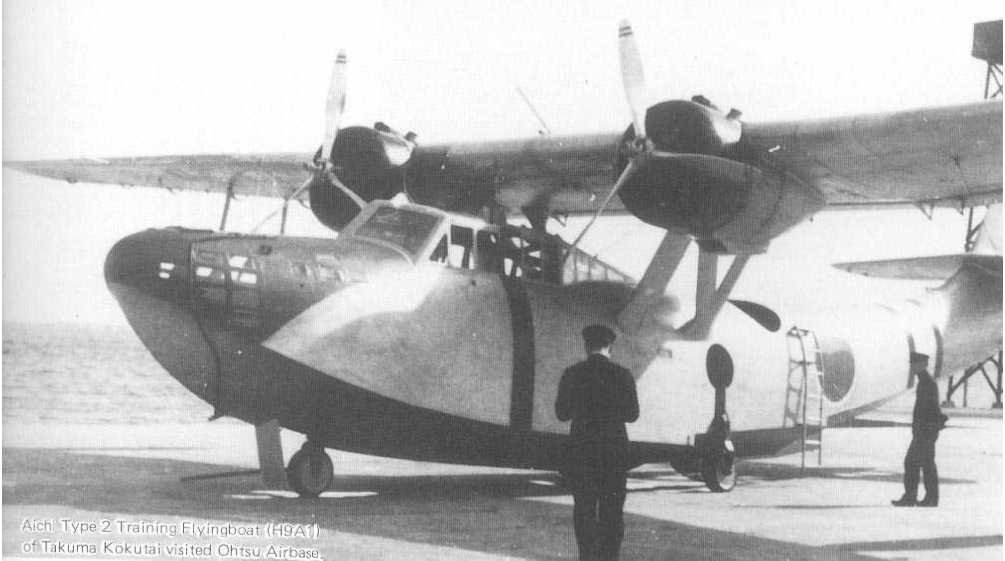
Aichi H9A
Aichi H9A: In-Depth Analysis of the Imperial Japanese Navy Training Flying Boat
The Aichi H9A stands as a unique example of wartime ingenuity—a twin-engined training flying boat developed for the Imperial Japanese Navy. Although not designed for frontline combat, the H9A played a crucial role in preparing aircrews for larger, more complex seaplanes such as the four-engined Kawanishi H8K. In service from the early 1940s through the end of World War II, this aircraft’s robust design, dependable performance, and versatility in varied secondary roles have secured its place in aviation history.
Development and Design
Origins and Mission Requirements
In the late 1930s and early 1940s, the Imperial Japanese Navy recognized the urgent need to modernize its training infrastructure for seaplane crews. With operational demands increasing as Japan’s naval aviation expanded, a new trainer was required—one that could reliably simulate the operational environment of larger combat seaplanes and provide comprehensive flight training. In response, Aichi Kokuki was assigned to develop the Navy Type 2 Training Flying Boat, a project that would ultimately produce the H9A.
This aircraft was conceived as a twin-engined, parasol-wing flying boat. It was designed not only to serve as an effective training platform but also to offer secondary capabilities such as liaison duties, anti-submarine patrols, and even limited transport roles. The H9A’s configuration, with its large floats for water operations and a robust airframe built to endure the harsh maritime environment, was optimized for high reliability and ease of maintenance—critical factors for training aircraft operating from scattered seaplane bases and aircraft carriers.
Structural Features and Configuration
The design of the Aichi H9A reflects a balanced combination of traditional seaplane construction techniques with innovations tailored to training requirements. Key features include:
- Parasol-Wing Layout: The wing is mounted high above the fuselage on struts—a configuration that enhances visibility for trainees and provides excellent lift characteristics at low speeds.
- Twin-Engine Arrangement: Powered by two air-cooled radial engines, the twin-engine configuration ensures redundancy—a vital safety feature for training scenarios.
- Robust Floats: Two large, streamlined floats allow the aircraft to operate efficiently on water, handling the stresses of takeoff and landing in maritime conditions while providing a stable platform for training.
- Mixed Construction Materials: Combining metal elements with fabric-covered control surfaces, the H9A was built for a balance of durability and weight savings, enabling forgiving handling characteristics that favored student pilots.
Throughout its development, the aircraft was refined through prototypes—three initial units tested various design aspects before the serial production version, known as the H9A1, entered service in greater numbers.
Technical Specifications
The Aichi H9A was produced in variants that exhibit slight differences in dimensions and performance figures. Below, a synthesis of the technical parameters—drawing from both Japanese and Allied documentation—provides an overview of the aircraft’s engineering.
Dimensions and Weight
Depending on the variant, the H9A’s dimensions were optimized for carrier-based operations and training efficiency:
- Length:
- Approximately 14.1 meters in some early models
- Later production variants (H9A1) measured around 16.95 meters (55 ft 7 in)
- Wingspan:
- Early versions featured a wingspan of about 19.0 meters
- H9A1 variants extended to approximately 24.0 meters (78 ft 9 in) to enhance lift and stability
- Height:
- Typically around 5.25–5.50 meters (17 ft 3 in to 18 ft)
- Wing Area:
- A substantial wing area of roughly 63.3 m² (681 sq ft) in later versions provided efficient cruising and low-speed handling
- Weights:
- Empty Weight: Early models weighed around 3,900 kg, while later H9A1 units typically had an empty weight near 4,900 kg (10,803 lb)
- Maximum Takeoff Weight (MTOW): Depending on configuration, values ranged between 5,400 kg to 7,500 kg
These dimensions ensured that the H9A could be compact enough for the limited space available on seaplane tenders and carriers, while still providing the lift and payload necessary for extensive training missions.
Powerplant and Propulsion
A key strength of the H9A was its reliable twin-engine powerplant configuration. The typical setup for the production H9A1 included:
- Engines:
- Two Nakajima Kotobuki radial engines—variants such as the Kotobuki 41 or later models like the Ha-1 Kotobuki 42/43 were common
- Power Output: Each engine produced approximately 710 horsepower (530 kW) for take-off, with slightly reduced power at higher altitudes
- Propellers:
- Three-bladed, fixed-pitch propellers provided the necessary thrust, optimized for both water takeoffs and medium-speed cruise performance
This dual-engine arrangement not only delivered a combined power output sufficient to propel the aircraft at respectable speeds but also offered critical redundancy—a valuable feature in a training aircraft where safety was paramount.
Performance Metrics
The operational performance of the Aichi H9A was well-suited to its training and secondary mission roles. Key performance parameters include:
- Maximum Speed:
- Early models reached speeds of around 280 km/h (174 mph)
- H9A1 variants could attain maximum speeds of up to approximately 317 km/h (197 mph)
- Cruise Speed:
- Generally maintained at around 200–222 km/h (124–138 mph) for efficient training profiles
- Range and Endurance:
- Operational range varied by configuration but typically fell in the vicinity of 1,700 km (in earlier models) to around 2,148 km (1,335 mi) for later variants, enabling long training sorties and extended patrol missions
- Service Ceiling:
- The aircraft could operate at altitudes up to 6,000–6,780 meters, which allowed trainees to experience high-altitude flight and enhanced operational scenarios
- Rate of Climb:
- With a climb performance around 4.5 m/s (890 ft/min), the H9A offered a responsive climbing capability—important for both training safety and mission flexibility
These figures reflect an aircraft designed primarily for training purposes while still capable of handling secondary operations such as anti-submarine patrols and liaison duties.
Armament and Defensive Systems
While the Aichi H9A was not intended to engage enemy aircraft in combat, minimal armament was incorporated for training in self-defense and to simulate operational conditions:
- Defensive Armament:
- A single flexible 7.7 mm machine gun was typically mounted in a rear defensive position, offering the trainee gunners practical experience in operating onboard weapons
- Bombing and Payload Options:
- The aircraft could be configured to carry light training bombs (often around 250 kg) or depth charges, enabling training crews to conduct bombing runs and familiarize themselves with payload management
These limited armaments underscored the H9A’s primary role as a trainer; however, they also ensured that crews gained exposure to the operational procedures they would use in front-line aircraft later in their careers.
Operational Role and Legacy
Training and Secondary Mission Roles
The primary mission of the Aichi H9A was as a training tool for the crews of Japan’s growing naval aviation fleet. Its roles included:
- Crew Training:
- Serving as a stepping stone for pilots, co-pilots, navigators, flight engineers, and gunners, the H9A provided realistic flight and water landing experiences essential for operating larger, combat-oriented flying boats.
- Liaison and Transport:
- In several instances, the H9A was deployed in secondary roles—such as transportation of personnel and light cargo between seaplane bases or carriers—demonstrating its versatility.
- Secondary Operational Use:
- Some H9A aircraft were employed in anti-submarine patrols and paratroop training missions, reflecting the strategic need to maximize the utility of available airframes during wartime.
Legacy and Impact
Though produced in relatively modest numbers—with prototypes, serial H9A1 units from Aichi, and additional units built by Nippon Hikoki—the H9A left a lasting legacy. Its contributions include:
- Enhanced Training Standards:
- The practical experience gained by thousands of trainees aboard the H9A helped form the backbone of the Imperial Japanese Navy’s air operations during World War II.
- Design Influences:
- The lessons learned during the H9A’s development and operational use influenced the design philosophies of subsequent Japanese seaplanes and training aircraft.
- Historical Significance:
- As a rarely encountered type by Allied forces—its primary role being behind the lines—the H9A represents a unique facet of Japan’s wartime aviation strategy, whose full dimensions are appreciated today by historians and aviation enthusiasts alike.
Conclusion
The Aichi H9A remains a notable example of specialized aviation design—a training flying boat that balanced practical performance with the need for durability and reliability in maritime operations. Its robust airframe, twin-engine configuration, and carefully optimized dimensions allowed it to serve effectively as a trainer and multi-role aircraft, preparing seaplane crews for the rigors of wartime operations.