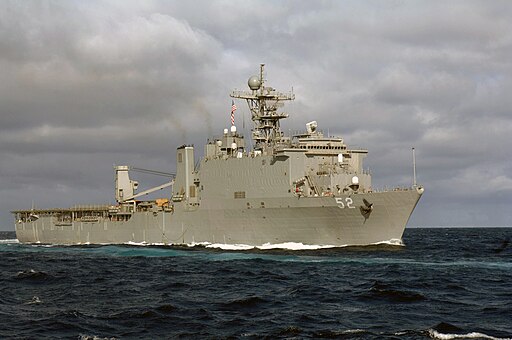
USS Pearl Harbor (LSD 52): Harpers Ferry–Class Dock Landing Ship
USS Pearl Harbor (LSD 52) is the tenth ship of the Harpers Ferry–class dock landing ships in service with the United States Navy. Commissioned in May 1998, she provides a flexible platform for transporting, launching, and recovering landing craft, vehicles, and embarked Marines in support of amphibious assaults and humanitarian missions.
Her namesake recalls the pivotal World War II harbor in Hawaii, underlining her role as a mobile expeditionary base capable of projecting power ashore or conducting disaster relief worldwide.
Design and Construction
Namesake and Shipbuilding
Pearl Harbor’s keel was laid on 27 January 1995 at Avondale Shipyards in New Orleans, Louisiana. She was launched on 24 February 1996 and officially commissioned into service on 30 May 1998 at Naval Station Norfolk. Her motto, “Nation’s Battle Cry,” reflects the spirit of rapid response and steadfast support for embarked forces.
Hull and Signature Reduction
Constructed with a steel hull and stealth-optimized superstructure, LSD 52 balances robustness for heavy well-deck operations with reduced radar cross-section. The hull form and machinery mountings are designed to minimize vibration and acoustic signature, enhancing her survivability and making her less detectable in littoral environments.
Technical Specifications
Dimensions and Displacement
| Characteristic | Value |
|---|---|
| Displacement (light) | 11,251 tons |
| Displacement (full load) | 16,088 tons |
| Length overall | 610 ft (190 m) |
| Beam | 84 ft (26 m) |
| Draft | 21 ft (6.4 m) |
These dimensions provide a spacious well deck and vehicle stowage area while maintaining maneuverability in confined waters.
Propulsion and Performance
| System | Specification |
|---|---|
| Main Engines | 4 × Colt Industries 16-cylinder diesels |
| Power | 33,000 shp (25 MW) |
| Propulsion | 2 shafts |
| Maximum Speed | 20+ knots (37+ km/h) |
| Range | ~6,000 nmi at cruising speed |
The diesel-electric drive offers fuel efficiency for sustained transit and reliable station-keeping during well-deck operations.
Weapon Systems
- 2 × Mk 38 25 mm remote-controlled gun mounts
- 2 × Phalanx CIWS 20 mm close-in weapon systems
- 2 × Rolling Airframe Missile (RAM) Mk 49 launchers
- 6 × .50-caliber M2HB machine guns
These provide layered point defense against small boats, aircraft, and missile threats during amphibious operations or self-defense in contested littorals.
Sensors and Electronics
- AN/SPS-67(V)3 surface search and navigation radar
- AN/SPS-73(V)9 surface search radar
- AN/SPS-49(V)5 2-D air search radar
- SLQ-32(V)1 electronic warfare suite
- Nulka decoy launchers
This sensor suite supports safe navigation, tactical awareness, and electronic protection for ship and embarked units.
Well Deck and Aviation Facilities
USS Pearl Harbor’s floodable well deck can accommodate:
- 2 Landing Craft Air Cushion (LCAC) hovercraft
- 1 Landing Craft Utility (LCU)
- 4 Landing Craft Mechanized (LCM-8) or 9 LCM-6
Her flight deck supports day/night helicopter operations, enabling vertical insertion of troops and cargo to remote or damaged airfields.
Operational History
Homeport and Deployments
Originally homeported at Naval Base San Diego, Pearl Harbor has deployed regularly to the Western Pacific and Central Command areas of responsibility. She has served with I-Marine Expeditionary Force and joined expeditionary strike groups, integrating with carrier strike and amphibious ready groups for combined operations.
Major Missions and Exercises
- 2008 Persian Gulf deployment supporting Operation Iraqi Freedom
- Pacific Partnership humanitarian missions across Samoa, Tonga, and the Marshall Islands (2013)
- RIMPAC amphibious exercises with allied navies (2016)
- Counter-piracy and maritime security patrols off Somalia and the Arabian Gulf
Her versatility has also seen her conduct disaster relief, evacuation support, and joint interoperability drills with regional partners.
Crew and Habitability
Pearl Harbor operates with approximately 24 officers and 397 enlisted sailors, complemented by up to 500 embarked Marines during full-spectrum operations. Enhanced berthing arrangements, mess facilities, and medical spaces support crew endurance on extended deployments.
Modernization and Future Upgrades
Undergoing periodic maintenance availabilities, LSD 52 is slated for modernization of communication suites, improved command-and-control systems, and hull-mounted sonar installations to expand her role in joint littoral maneuvers and undersea threat detection.
Strategic Role
As a Harpers Ferry–class LSD, USS Pearl Harbor delivers critical sealift and amphibious lift capacity, acting as a staging platform for expeditionary forces. Her ability to launch air-cushion craft and helicopters directly from the well deck makes her indispensable for assured access to austere or damaged shorelines, underpinning U.S. Navy power projection and humanitarian assistance worldwide.
_operates_in_the_Pacific_Ocean_in_support_of_UNITAS_Pacific_2007_which_supports_Partnership_of_the_Americas_(POA)_2007.jpg)