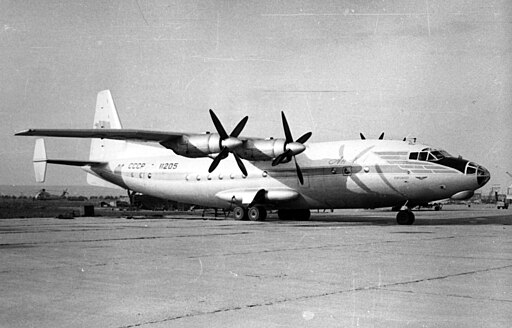
Antonov An-10
The Antonov An-10 emerged in the late 1950s as the Soviet Union’s first indigenous four-engined turboprop airliner. Designed to replace aging piston transports on medium-haul routes, it combined a capacious cabin with robust field performance. Its development marked a significant step for the Antonov bureau, transitioning from military freighters to passenger aircraft without compromising ruggedness or reliability.
Development History
Initial Design
In response to Aeroflot’s growing need for a modern airliner capable of carrying at least 70 passengers over 2,000 kilometers, Antonov’s design team began work in 1955. Drawing on experience with the An-8 military transport, engineers opted for a low-wing monoplane layout, pressurized cabin, and tricycle landing gear. Emphasis was placed on simple maintenance and modular components to ease operations across the vast Soviet network.
Prototype Testing
The An-10 prototype took to the air for the first time in February 1957. Flight trials focused on stability, pressurization integrity, and engine-out handling. Early tests revealed minor flutter at high speeds, which was addressed by stiffening the outer wing panels and adjusting counterweights on the ailerons. By mid-1958, the prototype had demonstrated continuous cruise at 500 km/h and climb rates exceeding 7 m/s.
Series Production
Full-scale production commenced in late 1958 at the Kyiv aircraft factory. Initial teething issues included inconsistent AI-20 turboprop reliability and cabin pressurization leaks. A series of engineering updates—improved oil seals, reinforced fuselage joints, and upgraded environmental control systems—resolved these challenges by 1960. Annual output peaked at 30 airframes before shifting resources to the larger Antonov An-12 freighter.
Airframe and Structure
Fuselage
The An-10’s semi-monocoque fuselage stretches 38.92 meters in length, offering a circular cross-section optimized for cabin comfort and structural integrity. Pressure bulkheads at both ends maintain a 0.45 kg/cm² differential. A large forward door and a smaller service hatch on the left side facilitate passenger boarding and galley servicing.
Wing
Featuring a straight, tapered wing with a 37.55 meter span, the An-10 employs double-slotted flaps and leading-edge slats for enhanced low-speed lift. The wing’s multi-cell aluminum alloy structure incorporates integral fuel tanks and foamed-core sandwich panels on the outer sections to reduce weight without sacrificing strength.
Landing Gear
Each main landing gear assembly retracts into streamlined pods beneath the wing roots. Dual wheels fitted with low-pressure tires distribute loads on unprepared runways. The steerable nosegear simplifies ground handling, while oleo-pneumatic shock absorbers ensure smooth touchdown. Quick-release fittings allow a main gear replacement in under 45 minutes.
Powerplant
Engine Selection
Power comes from four Ivchenko AI-20K two-shaft turboprops, each rated at 4,250 shaft horsepower. The modular engines feature removable power sections and accessory gearboxes, enabling front-line maintenance teams to execute major overhauls with minimal tooling.
Propellers and Fuel
Each engine drives a four-bladed constant-speed propeller with reversible pitch, constructed from composite-reinforced aluminum for durability and reduced inertia. Fuel is stored in six integral wing tanks holding a total of 9,500 liters of Jet A-1, delivering a maximum range of nearly 2,750 kilometers with full passenger load.
Flight Deck and Avionics
Cockpit Layout
The two-pilot cockpit incorporates a flight engineer station and an optional third crew member for long overwater routes. Instruments combine analog air data and engine gauges with early digital readouts for fuel quantities and pressurization. Environmental controls maintain a comfortable cabin altitude of 1,800 meters at cruise.
Navigation and Communication
Standard equipment includes VOR/ILS receivers, HF and VHF radios, and an automatic direction finder. Optional upgrades in later models added Doppler navigation and weather radar, improving all-weather capabilities on polar and maritime routes.
Cargo and Passenger Configurations
Typical Layouts
- Forward passenger cabin with 72 reclining seats in a 2–2 arrangement
- Galley and service area amidships
- Rear baggage hold accommodating up to 3,000 kg of luggage
Special Missions
Several An-10s were converted for VIP transport, featuring a lounge, conference table, and crew rest areas. Others served as aerial survey platforms, carrying cameras and magnetometers in belly pods for geological mapping.
Performance Characteristics
Speed and Range
- Maximum speed: 515 km/h
- Cruise speed: 500 km/h
- Ferry range: 2,750 km with standard payload
Takeoff and Landing
- Takeoff distance over 15 m obstacle: 1,800 m
- Landing distance over 15 m obstacle: 1,500 m
- Service ceiling: 9,800 m
- Climb rate (sea level): 8 m/s
These figures enabled the An-10 to serve secondary airports with short runways and minimal ground support.
Operational Service
Commercial Use
Between 1959 and 1972, Aeroflot deployed over 100 An-10s on domestic trunk routes, linking Moscow, Leningrad, Kiev, and the Trans-Siberian corridor. Passengers appreciated its quieter cabin and smooth ride compared to piston predecessors.
Military Deployments
The Soviet Air Force adapted a dozen An-10s for troop transport and medevac roles. Their pressurized cabins and ample floor space made them ideal for rapid casualty evacuation, while enhanced environmental systems supported operations in Arctic conditions.
Variants and Upgrades
- An-10A: Baseline production airliner with standard avionics
- An-10B: VIP transport featuring executive interior and extended galley
- An-10R: Reconnaissance version equipped with side-looking airborne radar
- An-10P: Polar variant with de-icing boots, strengthened skin, and enlarged drainage
In the late 1960s, modernization kits introduced improved AI-20M engines, noise-dampening insulation, and Doppler navigation to extend service life.
Technical Specifications
| Parameter | Value |
|---|---|
| Crew | 4 (two pilots, flight engineer, radio operator) |
| Passenger capacity | 72 |
| Length | 38.92 m |
| Wingspan | 37.55 m |
| Height | 10.40 m |
| Wing area | 110.3 m² |
| Empty weight | 29,200 kg |
| Maximum takeoff weight | 45,000 kg |
| Powerplant | 4 × Ivchenko AI-20K turboprops, 4,250 shp each |
| Maximum speed | 515 km/h |
| Cruise speed | 500 km/h |
| Range (ferry) | 2,750 km |
| Service ceiling | 9,800 m |
| Takeoff run (MTOW) | 1,800 m |
| Landing run (MTOW) | 1,500 m |
| Fuel capacity | 9,500 L |
