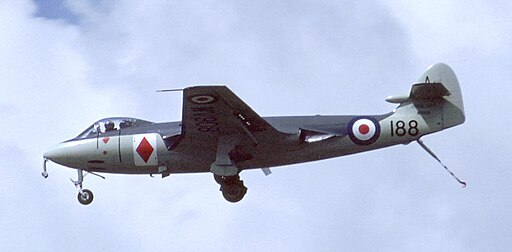
Hawker Sea Hawk
The Hawker Sea Hawk was the first jet-powered fighter produced by Hawker Aircraft and its sister company Armstrong Whitworth, serving primarily with the Fleet Air Arm of the Royal Navy from 1953 until its retirement in 1983. Designed by Sydney Camm’s team, it combined proven piston-engine airframe practices with a mid-fuselage turbojet layout to create a robust carrier-borne day fighter. It also found export success with the Indian, Dutch, and German navies, demonstrating versatility across several operational theaters.
Development and Origins
Post-WWII Jet Aspirations
As World War II drew to a close, Hawker’s engineers sought to transition from high-performance piston fighters like the Fury, Tempest, and Typhoon to a jet-powered design. They repurposed the Griffon-powered Fury prototype, replacing its piston engine with a Rolls-Royce Nene turbojet, and recontoured the nose to accommodate a new cockpit position at the very front of the fuselage. This concept, internally designated P.1035, laid the groundwork for the Sea Hawk’s airframe and layout.
Prototype to Production
Following Air Ministry evaluation in late 1944, Hawker refined the P.1035 design by stretching the fuselage, optimizing lateral intakes, and selecting the more powerful Nene over the Derwent engine. The first prototype flew on 2 September 1947, proving its basic aerodynamic and structural soundness. Production models entered service beginning in March 1953, featuring incremental updates to avionics, armament, and naval equipment such as an arrestor hook and reinforced undercarriage for carrier operations.
Design Characteristics
Airframe and Structural Design
The Sea Hawk’s semi-monocoque fuselage used light alloy skins over robust frames and longerons, ensuring carrier-landing resilience. Its mid-mounted straight wing incorporated integral fuel tanks and split flaps for short-field performance. Leading-edge slats improved low-speed handling during approach and deck landings, while wing fences reduced spanwise flow and enhanced roll control.
Powerplant and Performance
Powered by a single Rolls-Royce Nene Mk.103 turbojet, the Sea Hawk delivered 24 kN (5,400 lbf) of thrust. This engine, housed in a mid-fuselage bay with side intakes, drove performance metrics that included a maximum speed of 965 km/h (600 mph; 521 kt) and a service ceiling of 13,564 m (44,500 ft). Its combat radius of approximately 480 mi (772 km) balanced fuel capacity with weapons load, making it suitable for fleet air defense and ground-attack roles.
Aerodynamics and Flight Control
Straight wings and conventional tail surfaces gave the Sea Hawk predictable handling and stable low-speed characteristics crucial for carrier work. Manual flight controls operated via cables and pulleys, providing tactile feedback to pilots. Split trailing-edge flaps and leading-edge slats yielded low stall speeds, while differential ailerons ensured effective roll response even at high angles of attack.
Operational Variants
Sea Hawk Mk.100 Series
The initial Royal Navy variant, the Mk.101, featured basic day-fighter avionics and four 20 mm Hispano Mk V cannons. Subsequent Mk.103 and Mk.104 iterations introduced enhanced navigation, radio, and target-tracking equipment. Indian Navy Mk.100 models retained core performance but adopted local communications and identification systems for extended service into the 1980s.
Export Versions
The Royal Netherlands Navy operated Mk.50 aircraft, distinguished by tropicalized equipment and Dutch-language cockpit labels. Germany temporarily leased Mk.100 airframes for pilot transition training. The Indian Navy’s large fleet of Mk.100 aircraft conducted multiple upgrades in avionics while retaining the Nene powerplant throughout their operational lifespan.
Combat Service Records
Sea Hawks flew combat missions during the Suez Crisis of 1956, performing fleet air defense and ground-attack sorties with precision. In Indo-Pak conflicts, Indian Sea Hawks supported naval blockades and coastal strikes, leveraging their weapons load of rockets, bombs, and cannon rounds. Pilots praised the Sea Hawk’s reliability, ease of maintenance, and forgiveness in the demanding carrier environment.
Technical Specifications
| Parameter | Specification |
|---|---|
| Crew | 1 |
| Engine | Rolls-Royce Nene Mk.103 turbojet; 24.0 kN thrust |
| Max Speed | 965 km/h (600 mph; 521 kt) |
| Service Ceiling | 13,564 m (44,500 ft) |
| Combat Range | 772 km (480 mi; 417 NM) |
| Empty Weight | 4,800 kg (10,582 lb) |
| Max Takeoff Weight | 7,500 kg (16,535 lb) |
| Wingspan | 11.90 m (39 ft 1 in) |
| Wing Area | 25.8 m² (278 ft²) |
| Length | 12.30 m (40 ft 4 in) |
| Height | 3.00 m (9 ft 10 in) |
| Armament | 4 × 20 mm Hispano Mk V cannons; up to 907 kg stores |
Citation: Technical data from Armstrong Whitworth/Hawker Sea Hawk specifications.
Operational History
Royal Navy Fleet Air Arm
In Royal Navy service, squadrons operated Sea Hawks from light fleet carriers and full-size carriers, benefiting from its sturdy undercarriage and arrestor hook integration. Deck crews valued its straightforward engine layout for rapid turnarounds, while pilots commended its deck-landing stability and predictable approach characteristics.
Indian Navy and Dutch Naval Air Service
The Indian Navy’s Sea Hawks formed the backbone of its carrier-borne air group aboard INS Vikrant, remaining active through multiple upgrades until final retirement in 1983. Dutch Mk.50 squadrons flew from HNLMS Karel Doorman, conducting NATO patrols and demonstrating Sea Hawk’s export adaptability.
Legacy and Preservation
Although superseded by more advanced swept-wing fighters like the Supermarine Scimitar and De Havilland Sea Vixen, the Sea Hawk’s straightforward design influenced later Hawker jets such as the Hunter. Today, several restored airframes appear in museums and at airshows, preserved by aviation heritage organizations in the UK, Germany, and India. These flying examples continue to showcase the Sea Hawk’s pioneering role in naval jet aviation.
crop.jpg)