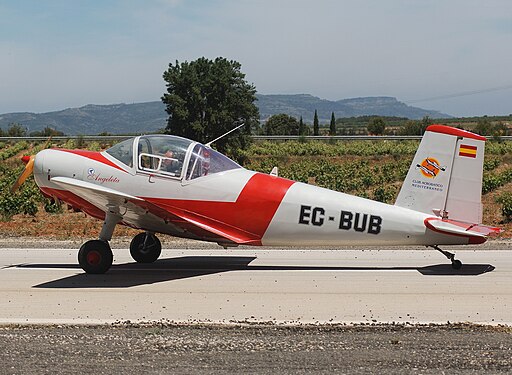
AISA I-11: Spain’s Postwar Light Trainer Reinvented
The AISA I-11 emerged in the late 1940s as a testament to Spain’s ambition to rebuild its aviation capabilities after World War II. Designed by Aeronáutica Industrial S.A. (AISA), this low-wing, two-seat monoplane combined simplicity with robust performance. Today, the I-11 stands as a remarkable example of mid-century trainer design, offering insights into airframe engineering, powerplant integration, and pilot-training methodologies of its era.
Historical Background
Origins and Development
In the aftermath of the Spanish Civil War, local demand for indigenous trainer aircraft skyrocketed. AISA responded by tasking its design bureau with a lightweight, affordable trainer that could be built with limited resources. The prototype took flight in 1948, powered by a 65-horsepower Continental A-65 piston engine. Rapidly recognized for its forgiving handling, the I-11 progressed through several engine and equipment upgrades to better serve evolving training requirements.
Production and Service Entry
By 1951, the I-11B entered production with a more powerful ENMASA Tigre G-IV engine rated at 125 hp. Spanish Air Force flight schools adopted the type en masse, praising its low operating costs and straightforward maintenance. Over 80 airframes rolled off the AISA assembly lines by the mid-1950s, with variants tailored to basic and advanced training roles.
Airframe and Structural Design
Fuselage and Cockpit
The I-11’s welded tubular steel fuselage frames are covered in doped fabric and lightweight aluminum panels. Tandem seating under a multi-section canopy ensures excellent visibility for instructor and student alike. The cockpit layout groups essential flight instruments—airspeed, altimeter, turn coordinator—in a simple “T” arrangement, minimizing pilot workload during initial flight instruction.
Wing Architecture
A classic low-wing layout with a 10 m span and a 15.2 m² area gives the I-11 a balanced lift distribution. Single-spar wings employ plywood ribs and fabric covering. Frise-type ailerons deliver crisp roll response, while split flaps extend to 40° for short-field approaches. Wing roots house fuel tanks, each holding 70 L, for a total internal capacity of 140 L.
Propulsion System
Engine Variants
– I-11 Prototype: Continental A-65, 65 hp – I-11A: ENMASA Tigre G-IV, 105 hp – I-11B: ENMASA Tigre G-IV, 125 hp with dual magnetos
The most widespread I-11B powerplant, an air-cooled four-cylinder inverted inline engine, features a two-stage carburetor and a ratio-adjustable pitch propeller. The installation prioritizes ease of access for routine inspections and oil changes.
Fuel and Oil Systems
A gravity-fed fuel system supplies the engine, with a manual fuel-selector valve for each wing tank. An engine-driven oil pump circulates 10 L of SAE 50 oil through a sheet-metal oil cooler mounted under the forward fuselage.
Flight Performance
Speed and Range
With the 125 hp Tigre engine, the I-11B achieves a maximum speed of 230 km/h at sea level and cruises comfortably at 200 km/h. Climb to 3,000 m takes approximately 11 minutes, aided by a climb rate of 4 m/s. Endurance on standard cruise settings approaches 4 hours, giving an effective range of 800 km with reserves.
Stall, Ceiling, and Manoeuvering
The clean-configuration stall speed sits around 75 km/h, dropping to 65 km/h with full flaps. Service ceiling reaches 4,500 m, limited by the engine’s naturally aspirated induction. The airframe withstands +6 G and −3 G, permitting basic aerobatic maneuvers such as loops and rolls under instructor supervision.
Avionics and Systems
Basic Instrumentation
Early I-11s carried only the essentials: magnetic compass, airspeed indicator, altimeter, turn-slip indicator, and engine tachometer. Later production models added a magnetic direction finder and a VHF radio capable of 118–136 MHz communications.
Optional Upgrades
Some civilian-owned restorations fit a basic GPS-enabled moving-map display and digital engine monitors. These modern touches maintain the aircraft’s vintage charm while enhancing pilot situational awareness.
Operational Roles
Primary Flight Training
The I-11’s docile handling characteristics made it ideal for ab initio pilot training. Instructors valued its stall behavior—predictable and easily recovered—while students appreciated the responsive controls that built stick-and-rudder skills.
Liaison and Reconnaissance
A handful of I-11s were outfitted for liaison duties, carrying stretchers or light cargo under the rear seat. The excellent low-speed visibility also lent itself to short-range aerial reconnaissance tasks.
Variants and Modifications
I-11A and I-11B
The I-11A introduced the 105 hp Tigre engine, boosting performance modestly. The definitive I-11B with 125 hp delivered better climb and cruise, becoming the backbone of AISA production.
Lightweight Sport Version
In the 1980s, a Spanish flying-club cooperative refitted three airframes with Rotax 912ULS engines (100 hp) and composite fairings. These restorations extended service life and cut fuel burn by 25 percent.
Technical Specifications
| Parameter | I-11B |
|---|---|
| Crew | 2 (student and instructor) |
| Length | 7.14 m |
| Wingspan | 10.00 m |
| Height | 2.35 m |
| Wing Area | 15.2 m² |
| Empty Weight | 480 kg |
| Max Takeoff Weight | 725 kg |
| Powerplant | ENMASA Tigre G-IV, 125 hp |
| Maximum Speed | 230 km/h |
| Cruise Speed | 200 km/h |
| Stall Speed (clean) | 75 km/h |
| Service Ceiling | 4,500 m |
| Rate of Climb | 4 m/s |
| Range | 800 km |
| Takeoff Distance (ground) | 180 m |
| Landing Distance | 200 m |
Maintenance and Support
Inspection Intervals
Airframe inspections occur every 100 flight hours, focusing on fabric integrity, rigging alignment, and corrosion checks in landing gear bays. Engine overhauls follow 1,200 hour TBO cycles.
Spare Parts Availability
Although AISA ceased operations decades ago, dedicated vintage-aircraft suppliers in Spain stock reproduction fabric kits, hardware, and new-build Tigre engine components, ensuring ongoing airworthiness for enthusiasts.
Legacy and Future Prospects
Museum and Warbird Appeal
Several I-11s now grace European aviation museums and fly-in gatherings. Their graceful lines and historic pedigree make them crowd favorites at vintage-aircraft airshows.
Potential Modernizations
Hobbyists have proposed electric conversion prototypes, pairing modern batteries and electric motors with the I-11’s lightweight structure. If realized, such conversions could blend historical design with zero-emission power for an eco-friendly trainer revival.
Conclusion
The AISA I-11 stands as a shining example of postwar ingenuity, offering straightforward handling, economical operation, and versatile training profiles. From its humble Continental-powered prototype roots to the definitive Tigre-driven I-11B, this aircraft charted a course that bridged Spain’s rebuilding aviation industry to modern flying clubs and museum collections. Its enduring legacy lies not only in the pilots it trained but in the story it tells of resourceful design and lasting affection.
