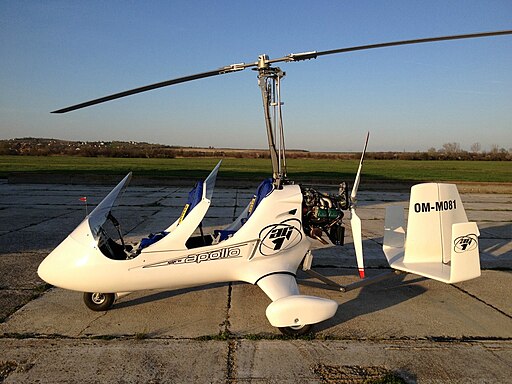
Apollo Gyro AG1
The Apollo Gyro AG1 is a tandem two-seat ultralight autogyro introduced in 2012 by Apollo Ultralight Aircraft of Eger, Hungary. Built as a ready-to-fly kit, it blends a robust stainless-steel frame with streamlined composite fairings to deliver both strength and aerodynamic efficiency. Its open-cockpit layout offers a visceral flying experience, while a quick-mount bubble canopy option adds versatility for cooler days or enhanced aerodynamics.
Design and Construction
Airframe and Fuselage
The AG1’s backbone is a welded stainless-steel framework engineered to withstand the rigors of sport flying. Over this skeleton, aerodynamically shaped fiberglass composite panels form a sleek fairing that channels airflow cleanly around the cockpit and engine bay. Reinforcements at critical junctions preserve structural integrity under repeated maneuvers.
Cockpit and Controls
Seats are arranged in tandem, with full dual-control capability for instructor-student use. The open cockpit provides unobstructed views, while two windshields protect occupants from airflow. An optional bubble canopy, weighing 20 kg, can be installed in under five minutes to reduce wind buffeting and improve comfort.
Rotor System
A two-blade main rotor made of aluminum alloy spans 8.4 m in diameter and covers just over 55 m² of disc area. The teetering-head design, paired with a pneumatic pre-rotator, enables rotor spin-up to flight RPM without taxing the engine. This arrangement supports immediate lift generation while preserving simplicity and low maintenance.
Landing Gear
The tricycle undercarriage features aluminum leaf-spring legs fitted with wheel pants for reduced drag. Each main wheel carries a hydraulic disc brake to aid ground steering and shorten landing roll. The shock-absorbing design tolerates firm touchdown forces common in training and sport operations.
Powerplant and Propulsion
Engine Options
Pilots choose between two Rotax powerplants:
- Rotax 912ULS: Four-cylinder, liquid-cooled, dual-ignition engine rated at 75 kW (100 hp).
- Rotax 914 Turbo: Turbocharged variant delivering 86 kW (115 hp) for improved high-altitude performance and heavier loads.
Both engines employ full-pressure lubrication, ensuring uninterrupted oil supply during inverted or aggressive flight profiles.
Propeller
A three-blade fixed-pitch composite propeller in pusher configuration delivers thrust behind the cockpit. Its lightweight, high-strength construction maximizes efficiency and keeps vibration levels low across the flight envelope.
Performance and Flight Characteristics
Speeds and Range
At gross weight, the AG1 can cruise reliably at 160 km/h, with a never-exceed limit near 180 km/h. Stall speed settles around 30 km/h, granting a wide speed margin for safe approaches. With a 60 L fuel tank, pilots can expect an operational range up to 300 km, depending on payload and atmospheric conditions.
Climb and Ceiling
Equipped with the 100 hp engine, climb rates approach 5 m/s, allowing rapid ascent to preferred traffic patterns or aerial sightseeing altitudes. The turbo-charged option sustains similar climb performance in thinner air, extending the practical service ceiling.
Handling and Stability
The AG1 exhibits neutral yaw characteristics and crisp roll response, a hallmark of its rotor-head geometry. Pitch authority remains positive throughout maneuvers, while inherent gyroscopic damping contributes to predictable behavior in turbulence.
Technical Specifications
| Parameter | Value |
|---|---|
| Crew | 1 pilot + 1 passenger |
| Empty weight | 256 kg |
| Maximum takeoff weight | 500 kg |
| Fuel capacity | 60 L |
| Rotor diameter | 8.4 m |
| Rotor disc area | 55.4 m² |
| Engine | Rotax 912ULS (100 hp) or Rotax 914 (115 hp) |
| Cruise speed | 160 km/h |
| Maximum speed (VNE) | 180 km/h |
| Stall speed | 30 km/h |
| Rate of climb | 5 m/s |
| Range | Up to 300 km |
Avionics and Equipment
Standard Features
The instrument panel includes essential flight instruments—airspeed indicator, altimeter, variometer, and engine tachometer. A simple electrical system powers lights, basic communication, and transponder interfaces.
Optional Upgrades
Owners often specify GPS navigation modules, digital angle-of-attack indicators, electronic variometers, COM radios, and lightweight transponders. Modular wiring harnesses allow rapid installation of weather sensors or autopilot sub-systems.
Variants and Modifications
- AG1 Open: Base configuration featuring dual windshields and open cockpit.
- AG1 Bubble: Fast-mount canopy upgrade for improved aerodynamics and comfort.
- AG1 Turbo: Factory-installed Rotax 914 turbocharger package for enhanced performance at higher altitudes or heavier gross weights.
Operational Use
Training and Sport Flying
Flight schools value the AG1 for its forgiving rotor characteristics and simple maintenance cycle. Tandem seating with dual controls makes it ideal for early autogyro training and aerobatic introduction.
Recreational Aviation
Private pilots appreciate the open-air experience, panoramic sightlines, and brisk cruise speeds. The quick-attach canopy extends the flying season into cooler months, broadening operational windows in temperate climates.
Maintenance and Support
Routine inspections center on rotor-head bearings, pre-rotator assemblies, and landing-gear pivot points. The corrosion-resistant frame alleviates many concerns typical of steel structures, though moisture control remains important. Rotax engines follow a 2 000-hour overhaul schedule, backed by a global service network.
Conclusion
The Apollo Gyro AG1 merges straightforward construction, reliable powerplants, and sport-oriented handling into a cohesive ultralight platform. Its combination of open-cockpit thrills, optional weather protection, and adaptable avionics makes it equally suited to student instruction, weekend touring, or competitive sport flying. For aviators seeking a robust, user-friendly gyroplane, the AG1 continues to set a high bar in its class.
