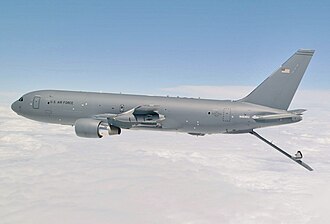
Boeing KC-46 Pegasus: The Next Generation Aerial Refueling Tanker Transforming Modern Air Power
A New Era in Military Aerial Refueling
The Boeing KC-46 Pegasus represents one of the most advanced aerial refueling aircraft ever developed, combining the proven reliability of a commercial airliner with cutting-edge military technology. Built to replace aging tanker fleets that have served for decades, the KC-46 is far more than a flying fuel station. It is a true multi-role military platform capable of conducting aerial refueling, strategic cargo transport, passenger movement, aeromedical evacuation, and global mobility missions. Designed around the highly successful Boeing 767 airframe, the Pegasus integrates modern avionics, advanced defensive systems, digital refueling technology, and extensive mission flexibility to meet the operational demands of 21st-century air forces.
For military planners, aerial refueling has become indispensable. Modern combat aircraft often require extended range to reach distant theaters of operation without relying on overseas bases, while strategic bombers, intelligence aircraft, and transport planes depend on airborne tankers to remain on station for extended periods. The KC-46 Pegasus was created to fulfill these requirements while introducing significantly improved survivability, automation, and operational efficiency compared to earlier generations of tanker aircraft. Today, the aircraft is becoming a cornerstone of the United States Air Force’s global mobility strategy and is attracting increasing interest from allied nations seeking a modern refueling capability.
The Origins of the KC-46 Pegasus
Replacing an Aging Tanker Fleet
By the beginning of the 21st century, the United States Air Force faced a significant challenge. Its fleet of KC-135 Stratotankers, many of which had entered service during the late 1950s, remained remarkably capable but were approaching the limits of economical long-term operation. Although continuous modernization programs had extended their service lives, structural fatigue, increasing maintenance costs, and evolving mission requirements made a replacement inevitable.
The search for a new aerial refueling aircraft became one of the most significant procurement programs in modern military aviation. The process proved lengthy and highly competitive, involving multiple proposals, contract disputes, and extensive evaluations before Boeing was ultimately selected to develop the KC-46 under the KC-X program. Drawing upon decades of experience with both commercial airliners and military aircraft, Boeing proposed a tanker derived from the highly successful Boeing 767-2C platform, balancing proven engineering with extensive military modifications.
From Commercial Airliner to Military Tanker
Although based on the Boeing 767, the KC-46 is far from a simple conversion. The aircraft underwent extensive redesign to accommodate military operations, including structural reinforcements, advanced fuel systems, defensive equipment, secure communications, military navigation systems, and specialized refueling hardware. Every major system was evaluated to ensure compatibility with demanding operational environments, allowing the Pegasus to support combat missions across the globe while maintaining the reliability associated with commercial aviation.
The first KC-46 prototype flew in December 2014, and after an extensive testing and certification campaign, the aircraft entered operational service with the United States Air Force in 2019. Despite experiencing several developmental challenges during its introduction, continuous software updates and engineering improvements have steadily enhanced its operational capability.
Aircraft Design and Engineering
A Modern Wide-Body Military Platform
One of the KC-46’s greatest strengths lies in its combination of commercial efficiency and military robustness. The aircraft measures nearly 50 meters in length and features a wingspan exceeding 47 meters, providing ample internal volume for fuel, cargo, passengers, and mission equipment. Its strengthened airframe enables it to withstand the unique stresses associated with aerial refueling operations while supporting frequent long-range deployments.
The Pegasus retains the aerodynamic efficiency of the Boeing 767 while incorporating military-grade systems throughout the aircraft. Advanced composite materials, strengthened landing gear, upgraded electrical systems, and reinforced cargo floors allow it to perform a wide variety of missions without sacrificing reliability or operational flexibility.
Advanced Cockpit Technology
The cockpit reflects decades of progress in aviation technology. Large digital displays replace traditional analog instruments, providing pilots with real-time situational awareness, aircraft performance information, navigation data, and mission status. Integrated flight management systems reduce pilot workload during long-duration missions, while modern autopilot capabilities enhance fuel efficiency and operational precision.
The aircraft is certified for global civilian and military airspace, allowing crews to seamlessly transition between commercial air traffic control environments and military operations. This flexibility significantly simplifies worldwide deployments.
The Refueling Mission
A New Generation Refueling Boom
The defining feature of the KC-46 Pegasus is its advanced fly-by-wire aerial refueling boom. Unlike older mechanical systems, the Pegasus employs electronically controlled flight surfaces that allow more precise boom movement during fuel transfer. This digital control system improves handling accuracy and reduces operator fatigue during complex refueling operations.
The aircraft can refuel a wide variety of military aircraft, including fighters, bombers, surveillance platforms, transport aircraft, and other tankers. The boom delivers fuel at exceptionally high transfer rates, allowing large aircraft to receive substantial amounts of fuel in relatively short periods.
Hose-and-Drogue Capability
In addition to its primary refueling boom, the KC-46 can be equipped with wing-mounted hose-and-drogue pods and a centerline drogue system. This enables compatibility with aircraft operated by the U.S. Navy, Marine Corps, NATO allies, and numerous international operators that utilize probe-and-drogue refueling systems.
This dual refueling capability makes the Pegasus one of the most versatile tanker aircraft in service, capable of supporting nearly every major Western military aircraft currently flying.
Remote Vision System: Innovation and Challenges
A Revolutionary Concept
Perhaps the most innovative aspect of the KC-46 is its Remote Vision System (RVS). Instead of lying in a rear observation compartment like operators aboard previous tanker aircraft, boom operators sit at modern workstations near the front of the aircraft. Using multiple high-definition cameras, infrared sensors, and stereoscopic displays, operators control the refueling boom remotely.
This configuration improves crew comfort, reduces fatigue during long missions, and allows greater flexibility in aircraft design. It also opens the possibility for future software enhancements without major structural modifications.
Continuous Improvements
The original Remote Vision System encountered several technical challenges after entering service, particularly involving depth perception under certain lighting conditions. Boeing and the U.S. Air Force have worked together to develop the improved RVS 2.0, featuring upgraded cameras, enhanced processing software, better displays, and improved image quality. These modifications are expected to significantly enhance operational effectiveness and further increase confidence in the system.
Multi-Role Mission Capability
Strategic Airlift
Although primarily designed as a tanker, the KC-46 also functions as an effective transport aircraft. It can carry military cargo on standard pallets, making it valuable during deployments when equipment must accompany fuel support assets. This capability improves operational efficiency by reducing the number of separate transport flights required during military operations.
The aircraft’s spacious cargo compartment allows transportation of vehicles, supplies, spare parts, and mission equipment while still retaining substantial fuel capacity for aerial refueling missions.
Passenger Transport
The Pegasus can transport over one hundred passengers depending on seating configuration. This makes it useful for troop movements, personnel rotations, humanitarian missions, and rapid deployments. Military planners appreciate the aircraft’s flexibility because a single sortie can simultaneously move personnel, cargo, and fuel support assets.
Aeromedical Evacuation
The aircraft can also be configured for medical evacuation missions. Equipped with litter stations, medical equipment, and onboard power systems capable of supporting intensive care devices, the KC-46 serves as a valuable platform for transporting injured personnel over long distances while providing continuous medical care during flight.
Survivability and Defensive Systems
Unlike commercial airliners, the KC-46 is designed to operate in potentially hostile environments. The aircraft incorporates radar warning receivers, missile warning sensors, defensive countermeasure systems, secure military communications, and cockpit armor in selected areas. These systems significantly improve survivability during military operations where threats may include surface-to-air missiles or hostile aircraft.
The Pegasus is not intended to operate directly within heavily defended enemy airspace, but its defensive suite allows it to function closer to operational areas than previous generations of tanker aircraft, providing greater flexibility for combat commanders.
International Operators and Future Growth
The United States Air Force remains the largest operator of the KC-46 and plans to acquire nearly 180 aircraft as part of its long-term tanker modernization strategy. Deliveries continue as older KC-135 aircraft gradually retire.
International interest has also grown steadily. Japan became the first export customer, followed by Israel, while additional countries continue evaluating the Pegasus for future procurement programs. As allied nations seek interoperability with U.S. forces and NATO partners, the KC-46 offers a standardized solution capable of supporting multinational operations.
Future upgrades are expected to include improved networking capabilities, enhanced mission systems, software modernization, expanded defensive technologies, and continued improvements to the Remote Vision System. These developments should ensure the aircraft remains operationally relevant well into the second half of the 21st century.
The Strategic Importance of the KC-46 Pegasus
Air superiority depends not only on advanced fighters but also on the logistical infrastructure that keeps them airborne. Tanker aircraft extend the operational reach of combat aircraft, strategic bombers, surveillance platforms, and transport fleets, making them force multipliers rather than simple support assets.
The KC-46 embodies this philosophy by combining aerial refueling with strategic transport capabilities, advanced avionics, modern defensive systems, and digital technologies that prepare it for future operational requirements. As military operations become increasingly global and expeditionary, aircraft capable of supporting multiple mission types from a single platform will become even more valuable.
The Pegasus demonstrates how commercial aviation technology can be successfully adapted for military use while incorporating innovations specifically designed for combat support operations. Its versatility ensures that it will remain one of the world’s most important aerial refueling aircraft for decades to come.
Boeing KC-46 Pegasus Technical Specifications
| Specification | Details |
|---|---|
| Manufacturer | Boeing |
| Primary Role | Multi-role aerial refueling and military transport aircraft |
| Program | KC-X Tanker Replacement |
| Based On | Boeing 767-2C |
| First Flight | 28 December 2014 |
| Entered Service | 2019 |
| Crew | 3 (2 pilots and 1 boom operator) |
| Length | 50.5 m (165 ft 7 in) |
| Wingspan | 47.6 m (156 ft 1 in) |
| Height | 15.8 m (51 ft 10 in) |
| Maximum Takeoff Weight | 188,240 kg (415,000 lb) |
| Engines | 2 × Pratt & Whitney PW4062 turbofan engines |
| Thrust (each) | 282 kN (63,300 lbf) |
| Maximum Speed | Approximately 915 km/h (570 mph) |
| Cruise Speed | Approximately 850 km/h (530 mph) |
| Ferry Range | Approximately 12,200 km (7,580 miles) |
| Service Ceiling | 12,200 m (40,000 ft) |
| Maximum Fuel Capacity | Approximately 96,300 kg (212,299 lb) |
| Cargo Capacity | Up to 29 standard 463L pallets |
| Passenger Capacity | Up to 114 passengers |
| Aeromedical Capacity | Up to 58 patients plus medical attendants |
| Refueling Systems | Fly-by-wire boom, centerline drogue, wing aerial refueling pods |
| Primary Missions | Aerial refueling, cargo transport, passenger transport, medical evacuation, humanitarian assistance |
.jpg)