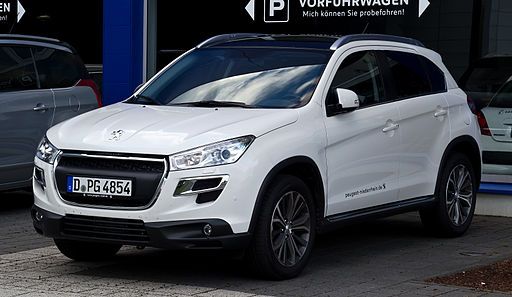
Peugeot 4008 faults
Here is a list of common and known malfunctions in the Peugeot 4008, which was produced between 2012 and 2017 and is largely based on the Mitsubishi ASX:
1. CVT Transmission Issues
-
Jerky or hesitant acceleration
-
Shuddering during low-speed driving
-
Transmission fluid overheating or early wear if not maintained properly
2. Electrical System Faults
-
Dashboard warning lights appearing intermittently
-
Keyless entry or start system failing
-
Blower fan or window switches malfunctioning
3. Suspension Wear
-
Noises from front struts or rear suspension over bumps
-
Worn bushings, especially in control arms and anti-roll bar links
-
Premature wear of shock absorbers
4. Engine Performance Problems
-
Rough idling or hesitation under acceleration (mainly petrol engines)
-
Carbon buildup in intake system
-
Oil leaks around the valve cover or timing chain tensioner
5. Air Conditioning and Climate Control
-
Weak airflow or no cooling
-
Compressor failure or gas leakage
-
Temperature sensors giving inaccurate cabin readings
6. Interior Quality Issues
-
Rattling from dashboard or trim in cold weather
-
Fading or peeling of soft-touch surfaces
-
Infotainment system freezing or slow response
7. Fuel System and Sensors
-
Fuel pump relay or sensor failures
-
Hard starting, especially in colder climates
-
Inaccurate fuel gauge readings
8. Brake System Malfunctions
-
Squealing brakes or uneven pad wear
-
Rear brake caliper seizure
-
ABS warning lights due to faulty wheel sensors
9. Battery and Charging Problems
-
Short battery life in models with stop-start system
-
Faulty alternator or voltage regulator
-
Sudden loss of electrical power
10. Rust and Body Seals
-
Rust formation around door edges or underbody (in salty climates)
-
Water ingress into cabin or boot due to faulty door or hatch seals
Peugeot 4008 as a used car
The Peugeot 4008 sits at an intriguing crossroads in the brand’s SUV story. Launched in 2016 for markets like China and select Asian countries, it marries French styling flair with dependable underpinnings borrowed from its Mitsubishi-sourced cousin. Although production ended in 2019, the 4008 lives on in the used-car market as a compact crossover that balances sharp looks, spirited engines and an optional all-wheel-drive system. For anyone hunting a second-hand 4008 today, understanding its technical DNA, typical wear points and ownership costs is essential.
Design and Packaging
Exterior Styling
Peugeot dialed up elegance on the 4008’s sheetmetal. A bold grille framed by slender LED daytime running lights stretches between chunky wheel arches. Side profiles feature a rising beltline and blackized roof pillars, giving the roof a “floating” effect. Buyers could choose alloys from 17″ up to 19″, often finished in two-tone patterns on higher trims.
Interior Layout and Cabin Space
Step inside to discover a binary split between rugged plastics down low and soft-touch materials on the dashboard. The driving position is commanding; a leather-rimmed steering wheel sits just below eye level, pointing toward a digital instrument cluster that’s easy to read at a glance. Front seats are cushioned yet supportive; rear passengers enjoy enough shoulder and knee room for two adults on medium-length journeys. The 425-liter boot swells to over 1,200 liters with the 60/40 split rear bench folded flat.
Engine Lineup and Performance
1.6-Litre THP Turbo
- Power: 165 hp at 6 000 rpm
- Torque: 240 Nm from 1 400 to 4 000 rpm
- Gearboxes: 6-speed manual or 6-speed Aisin automatic
- Fuel consumption: around 7.3 L/100 km combined
- 0–100 km/h: 8.9 s
The 1.6-THP stands out for its eager throttle response and flexible midrange. It rewards an enthusiastic right foot but can show high oil consumption if intervals stretch beyond 12 000 km.
1.8-Litre DVVT Petrol
- Power: 130 hp at 6 000 rpm
- Torque: 172 Nm at 4 200 rpm
- Gearboxes: 5-speed manual or CVT with “sport” mode
- Fuel consumption: around 7.8 L/100 km combined
- 0–100 km/h: 11.2 s
A smooth-running four-cylinder, the 1.8-litre DVVT is refined around town. Its CVT can feel rubber-bandy under hard acceleration, so manual-gearbox examples are often more engaging.
2.0-Litre DVVT Petrol
- Power: 150 hp at 6 100 rpm
- Torque: 196 Nm at 4 200 rpm
- Gearboxes: 6-speed automatic only
- Fuel consumption: around 8.2 L/100 km combined
- 0–100 km/h: 10.3 s
The 2.0-litre trades outright pace for a calmer engine note. Its torque curve helps when hauling passengers or luggage, though fuel use climbs accordingly.
Drivetrain and Off-Road Ability
Every 4008 comes standard front-wheel drive, with an optional coupling-based all-wheel-drive system. A dashboard selector lets you switch between 2WD, automatic AWD and lock mode (splitting torque 50/50 front to rear). Ground clearance of 190 mm combined with hill-descent control makes light off-road excursions and snowy country lanes comfortably within its remit—but serious rock-crawling is out of scope.
Technical Specifications
| Parameter | 1.6 THP | 1.8 DVVT | 2.0 DVVT |
|---|---|---|---|
| Power | 165 hp / 121 kW | 130 hp / 96 kW | 150 hp / 110 kW |
| Torque | 240 Nm | 172 Nm | 196 Nm |
| Transmission | 6-speed manual / 6-spd auto | 5-spd manual / CVT | 6-spd automatic |
| Fuel consumption | 7.3 L/100 km | 7.8 L/100 km | 8.2 L/100 km |
| 0–100 km/h | 8.9 s | 11.2 s | 10.3 s |
| Top speed | 205 km/h | 190 km/h | 198 km/h |
| Boot capacity | 425–1 250 L | 425–1 250 L | 425–1 250 L |
| Curb weight | 1 365–1 430 kg | 1 380–1 455 kg | 1 400–1 505 kg |
| Towing capacity | 1 300 kg braked | 1 300 kg braked | 1 300 kg braked |
| Ground clearance | 190 mm | 190 mm | 190 mm |
Reliability and Known Weak Spots
Engine and Drivetrain
• The 1.6-THP turbo can suffer high oil consumption and occasional timing-chain stretch if services lapse. • CVT boxes on 1.8-litre models may overheat under heavy load; fluid changes every 60 000 km prolong life. • Automatic-transmission 2.0-litre units are generally robust but check for smooth shifts and sensor-error warnings.
Suspension and Chassis
• Shock-absorber seals can leak after 80 000 km, leading to a softly sprung ride and bark-and-clunk noise over bumps. • Rubber suspension bushes tend to crack in harsher climates; listen for creaks on full-lock turns. • Corrosion is minimal on well-maintained cars, but inspect lower door edges and wheel arches if the vehicle spent winters on salted roads.
Electronics and Comfort Systems
• Infotainment software may stall or reboot—latest firmware flashes cure most bugs. • Electric tailgate mechanisms are known to hesitate in cold weather. • Climate-control actuators sometimes produce clicking noises; airflow performance remains unaffected.
Buying Guide for a Used 4008
Checklist Before Purchase
- Service record: look for oil changes ≤12 000 km intervals, CVT/auto-transmission fluid services, and timing-chain/chain-tensioner work on the THP engine.
- Diagnostic scan: confirm no pending faults in engine, transmission or AWD coupling system.
- Test drive: cover urban streets, open country roads and a slippery surface to exercise the 4WD system and hill-descent control.
- Underbody inspection: check for oil leaks around the turbo, gearbox and rear-axle coupling unit.
Price Ranges and Depreciation
In Central Europe today, you’ll typically see:
- Early (2016–2017) 1.8 DVVT manuals from €8 000 to €11 000.
- Mid-cycle 1.6 THP automatics from €10 500 to €13 500.
- Late-run 2.0 DVVT automatics up to around €14 000, depending on spec and mileage.
Depreciation has slowed since the 4008 was withdrawn in 2019, making well-kept examples hold their value better than many rivals.
Ownership Costs
Fuel and Running Expenses
Plan on annual fuel bills of roughly €1 200–€1 600 for typical 15 000 km mileage. Tyre replacements on 18″ wheels cost about €550 a set, with brake-pad changes near €300 per axle.
Scheduled Maintenance
Independent workshops charge around €180–€260 for basic oil and filter services. Automatic gearbox fluid changes run €200–€300. Timing-chain inspection or tensioner replacement on the THP engine can reach €500 if done proactively.
Insurance and Taxation
Insurance premiums sit mid-range for compact SUVs, influenced most by engine choice and driver history. Road tax in many markets ties to CO₂ output (from roughly 165 g/km on the 2.0 to 168 g/km on the turbo), placing the 4008 in a moderate bracket.
Pros and Cons
Pros
- Distinctive styling and premium-feel interior
- Flexible engine lineup with turbocharge or naturally aspirated options
- Optional part-time AWD and hill-descent control
- Spacious, well-finished cabin with a versatile boot
Cons
- THP turbo demands diligent servicing to avoid oil-consumption issues
- CVT variants lack the crisp response of manuals or torque-converter automatics
- Electronics quirks on infotainment and tailgate in colder climates
- Scarce availability of replacement panels in some markets
Conclusion and Next Steps
The Peugeot 4008 makes a compelling case as a used compact crossover for drivers craving style, cabin refinement and occasional off-road confidence. If you prioritise low running costs and simplicity, the 1.8 DVVT manual is a relaxed town and country partner. For quicker commutes or motorway overtakes, the 1.6 THP (when well-serviced) brings genuine spark. Whichever route you choose, a full service history, recent gearbox or CVT fluid change and a thorough test drive are non-negotiable.
