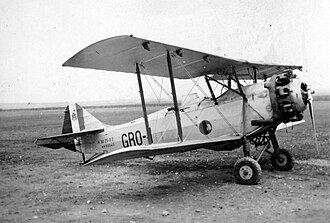
Breda Ba.25: Italy’s Classic Biplane Trainer
The Breda Ba.25 was one of the most important Italian military training aircraft of the interwar period and remained a familiar sight at Italian flying schools into the early years of the Second World War. Developed by Società Italiana Ernesto Breda as a successor to the earlier Breda A.9, the Ba.25 combined a conventional biplane layout with the robust construction and forgiving handling qualities needed to prepare military pilots for more demanding aircraft. Its first flight took place in 1931, and production began the following year. Powered initially by the 260-horsepower Isotta Fraschini Asso 200 engine, the Ba.25 was developed in several configurations, including single-seat and dual-control trainers, and later aircraft could be fitted with alternative engines. More than 700 examples of the various versions were built, with the type becoming a central component of the Regia Aeronautica’s pilot-training system. The Ba.25 was not a glamorous fighter or a fast bomber, but its importance came from a different role: it helped create the pilots who would eventually fly Italy’s frontline aircraft.
The Origins of the Breda Ba.25
The Ba.25 grew directly out of Breda’s experience with the Breda A.9, an advanced trainer developed during the late 1920s. The A.9 had demonstrated the usefulness of a dedicated military training biplane, but aviation technology was developing rapidly. Training aircraft needed to become stronger, more practical and easier to operate as pilot instruction became increasingly systematic. Breda therefore developed a successor that retained the basic philosophy of the A.9 while incorporating structural and mechanical improvements.
The new aircraft was designed as a conventional single-engine biplane with two open cockpits arranged in tandem. Its wooden wings were fabric-covered, while the fuselage used a welded steel-tube framework covered with fabric. This combination gave the aircraft a useful balance of strength, repairability and relatively low weight. The landing gear was also revised compared with the A.9, using independent wheels rather than the older tailskid arrangement. The result was an aircraft that looked unmistakably like a product of the early 1930s but was better adapted to the increasingly demanding requirements of military flight training.
From the A.9 to a More Capable Trainer
The relationship between the two aircraft is important because the Ba.25 was not an entirely new concept. Breda retained the general biplane configuration that had worked well on the A.9, but the newer design incorporated a stronger fuselage and improved undercarriage. The basic engine installation also remained familiar, with the 260-horsepower Isotta Fraschini Asso 200 continuing to provide the power for early Ba.25 aircraft.
This evolutionary approach made sense for a military customer. A completely new aircraft would have required new training procedures, new maintenance practices and potentially new production facilities. By refining an existing successful concept, Breda could provide the Regia Aeronautica with an aircraft that was modern enough to address its needs without abandoning the characteristics that had already proved useful in training.
The Ba.25 consequently became an excellent example of incremental aircraft development. Its importance did not depend on revolutionary technology. Instead, it was the result of getting many practical details right.
A Classic Italian Biplane
The appearance of the Breda Ba.25 reflects the final generation of successful military biplanes. Its two wings provided a large lifting surface within a relatively compact span, while the conventional fixed landing gear simplified operation and maintenance. The engine was installed at the front of the fuselage, with the student and instructor positioned one behind the other in open cockpits.
For pilot training, this arrangement had several advantages. The instructor could occupy the rear cockpit and maintain a clear view of the student’s actions, while the student enjoyed a cockpit environment that was broadly representative of the operational aircraft of the period. The aircraft’s relatively low-speed handling also gave instructors an effective platform for teaching fundamental flight skills.
The fabric-covered structure was equally appropriate for a trainer. Military training aircraft inevitably experienced hard landings, frequent takeoffs and repeated handling by students. A structure that could be repaired relatively easily was therefore highly valuable. The Ba.25’s construction philosophy allowed maintenance personnel to work with techniques and materials already familiar within the Italian aviation industry.
Why Biplanes Remained Useful
By the early 1930s, monoplanes were already demonstrating significant aerodynamic advantages. Their lower drag and cleaner airframes would soon make them dominant in fighter design. Yet biplanes remained attractive for training because they offered good low-speed characteristics and strong structural efficiency.
A training aircraft did not need to be the fastest machine available. It needed to give students predictable responses and enough time to understand what the aircraft was doing. The Ba.25’s biplane configuration provided those qualities while also allowing it to perform aerobatic exercises.
This was particularly important because the aircraft was used for both elementary and advanced stages of training. The Ba.25 was not simply a machine for teaching students how to taxi and land. It could remain useful as students progressed toward more demanding maneuvers and eventually moved on to operational aircraft.
The Isotta Fraschini Asso 200
The early Ba.25 was powered by the Isotta Fraschini Asso 200, a 260-horsepower liquid-cooled inline engine. This powerplant had already been used by the earlier Breda A.9 and gave the Ba.25 sufficient performance for its intended role.
The engine’s output was considerable for a training aircraft of the period. It allowed the Ba.25 to achieve a maximum speed of approximately 204 km/h according to the Aeronautica Militare’s historical data. The engine also provided enough power for aerobatic training and useful climbing performance.
As production continued, the Ba.25 was also adapted to alternative engines. Some aircraft received the 200-horsepower Alfa Romeo 115, while other versions used different powerplants depending on availability and operational requirements. The ability to accommodate different engines increased the aircraft’s usefulness and helped extend its service life.
Engine Changes and the Ba.25D
One notable development was the Ba.25D, which used a 200-horsepower Alfa Romeo 115 engine. This version formed part of the continuing evolution of the type as Italy’s aircraft-engine industry developed. Although the lower engine output might appear to represent a step backward, the Alfa Romeo engine offered its own advantages in terms of availability and integration into the Italian military supply system.
The use of several engines also means that performance figures for the Ba.25 should always be treated with some caution. A Ba.25 equipped with an Asso 200 could have different speed, climb and weight characteristics from an aircraft fitted with an Alfa Romeo 115. Historical references therefore sometimes provide different specifications depending on which variant they describe.
Service With the Regia Aeronautica
The Ba.25 entered military production in June 1932 and rapidly became an important component of Italian pilot training. According to the Aeronautica Militare, 661 examples were produced between 1932 and 1942. Initially intended for advanced training, the aircraft was also assigned to other flight schools from 1937.
This long production period is significant. An aircraft designed at the beginning of the 1930s remained useful throughout a decade of enormous technological change. During those years, aviation moved from fabric-covered biplanes toward all-metal monoplanes, retractable landing gear and increasingly powerful engines. The Ba.25 survived this transition because its mission was not to compete with frontline aircraft. It needed to provide an effective foundation for pilot training.
The aircraft therefore became part of the institutional infrastructure of Italian military aviation. Thousands of training flights were carried out in aircraft of this general class, and the Ba.25 helped prepare pilots who would later transition to more advanced trainers and combat aircraft.
Training for a Rapidly Changing Air Force
The importance of the Ba.25 becomes clearer when viewed against the expansion of the Regia Aeronautica during the 1930s. Italy was investing heavily in aviation, and the number of aircraft and pilots needed by the military was increasing. A training system capable of producing pilots in large numbers was essential.
The Ba.25’s relatively straightforward design made it well suited to this task. It could be operated frequently, maintained using conventional techniques and used for multiple phases of instruction. The same aircraft could therefore remain useful for a substantial portion of a student’s training.
Its success also demonstrated the value of standardization. Once a training aircraft became widely established, instructors and maintenance personnel could develop considerable familiarity with its characteristics, reducing the learning curve associated with operating a new type.
The Ba.25 in Civilian Flying
Although its principal importance was military, the Ba.25 was also associated with civilian aviation. Some examples were operated by Italian flying clubs and other organizations, where their robust construction and two-seat arrangement made them suitable for training and recreational flying.
The transition between military and civilian use was not unusual during this era. Training aircraft were particularly adaptable because their basic purpose—teaching pilots—was relevant to both military and civilian organizations. A sturdy aircraft designed to survive repeated training flights could be just as useful at an aeroclub.
Civilian operation also extended the life of some aircraft beyond their original military careers. Once a military aircraft was retired, it could potentially be sold or transferred to civilian operators rather than being immediately scrapped.
The Ba.25 in Wartime
When Italy entered the Second World War in 1940, the Ba.25 was already an older design. Yet its role as a trainer meant that it continued to have practical value. Frontline aircraft were changing rapidly, but new pilots still needed to learn basic and intermediate flying skills before progressing to more advanced machines.
The Ba.25 was therefore part of the training environment during the early years of the conflict. Its performance was no longer comparable with modern fighters, but that was not its purpose. Training aircraft were judged by their reliability, handling and suitability for instruction rather than by their ability to compete in combat.
Some Ba.25s continued flying even after more modern trainers had entered service. Their longevity reflected the fact that the fundamental requirements of pilot training did not change as quickly as combat technology.
A Transitional Aircraft
The Ba.25 is particularly interesting because it belongs to a transitional generation. A student learning to fly a Ba.25 in the early 1930s was learning in a biplane with an open cockpit and fixed landing gear. Within a few years, that same pilot might be expected to fly an enclosed-cockpit, all-metal monoplane with retractable landing gear.
The training aircraft therefore served as a bridge between two technological worlds. It provided the basic skills—aircraft control, navigation, takeoff and landing, aerobatics and formation flying—that remained relevant even as aircraft technology changed dramatically.
The Breda Ba.28 and Further Development
Breda continued to develop its training aircraft beyond the Ba.25. The Ba.28 represented another stage in the company’s attempts to provide modern training aircraft to the Italian aviation system. The later design retained the general philosophy of a dedicated trainer but incorporated changes intended to keep pace with contemporary requirements.
The Ba.28 did not achieve the same production success as the Ba.25, but the progression illustrates how Breda’s experience with trainers continued to influence subsequent designs. The Ba.25 had established that there was a strong requirement for reliable, mass-produced training aircraft, and the company continued to compete for that market.
The development history also shows why the Ba.25 remained relevant for so long. It was not simply a single aircraft model frozen in time. It existed within a broader family of Italian trainer development in which lessons from one design influenced the next.
The Ba.25’s Place in Italian Aviation History
The Breda Ba.25 is sometimes overshadowed by the better-known Italian aircraft that fought in Spain, North Africa and the Mediterranean. Yet from the perspective of aviation infrastructure, the trainer was arguably just as important. A fighter squadron could not operate effectively without trained pilots, and the pilots who eventually flew Italy’s combat aircraft had to begin somewhere.
The Ba.25 provided that starting point for a large number of Italian aviators. Its long production run and extensive use by flight schools ensured that it became one of the familiar aircraft of Italian military aviation during the 1930s.
Its significance is also technological. The Ba.25 shows how quickly the role of a training aircraft could change. When it was introduced, its biplane configuration represented a modern and effective approach. By the beginning of the 1940s, it was technologically conservative, but still useful because the underlying principles of flight instruction remained the same.
Conclusion
The Breda Ba.25 deserves recognition as one of the most important training aircraft in the history of Italian aviation. Developed from the earlier A.9, it combined a conventional biplane layout with a stronger welded-steel-tube fuselage, improved landing gear and a 260-horsepower Isotta Fraschini Asso 200 engine. Its design was not revolutionary, but it was carefully matched to the practical demands of pilot training.
The aircraft entered production in 1932 and remained in production until 1942, with 661 examples built according to the Aeronautica Militare. During that decade it served at numerous Italian flying schools and helped prepare pilots for increasingly sophisticated military aircraft.
What makes the Ba.25 particularly interesting is its longevity. It survived a period in which aviation technology changed at extraordinary speed. While fighters moved from biplanes to fast monoplanes and aircraft construction shifted toward metal structures, the Ba.25 continued to fulfill its essential training mission. Its relatively simple construction, predictable handling and adaptability made it useful long after its original technology had ceased to be cutting-edge.
The Ba.25 should therefore be remembered not merely as an old Italian biplane, but as a fundamental part of the system that created military aviators. Its contribution was measured not in combat victories or record-breaking speeds, but in the countless training flights through which inexperienced students became pilots. In that respect, the Breda Ba.25 occupies an important and often underappreciated place in the history of the Regia Aeronautica and Italian aviation as a whole.
Breda Ba.25 Technical Specifications
The figures below describe the principal Ba.25 configuration and should be regarded as representative. Exact specifications varied between versions, particularly when different engines were installed. The principal dimensions and performance figures follow historical information published by the Aeronautica Militare.
| Specification | Breda Ba.25 |
|---|---|
| Aircraft type | Advanced military training biplane |
| Manufacturer | Società Italiana Ernesto Breda |
| Country of origin | Italy |
| First flight | 1931 |
| Production start | June 1932 |
| Primary operator | Regia Aeronautica |
| Crew | 2 |
| Configuration | Single-engine biplane |
| Cockpit arrangement | Tandem, open cockpits |
| Construction | Welded steel-tube fuselage; wooden, fabric-covered wings |
| Engine | Isotta Fraschini Asso 200 |
| Engine power | 260 hp (194 kW) |
| Alternative engine | Alfa Romeo 115, 200 hp (149 kW), on Ba.25D |
| Length | Approximately 7.55 m (24 ft 9 in) |
| Wingspan | Approximately 10.52 m (34 ft 6 in) |
| Wing area | Approximately 28 m² (301 sq ft) |
| Height | Approximately 2.95 m (9 ft 8 in) |
| Empty weight | Approximately 1,050 kg (2,315 lb), configuration dependent |
| Maximum take-off weight | Approximately 1,450 kg (3,197 lb), configuration dependent |
| Maximum speed | Approximately 204 km/h (127 mph) |
| Cruising speed | Approximately 175 km/h (109 mph), configuration dependent |
| Service ceiling | Approximately 5,500 m (18,000 ft), source/configuration dependent |
| Landing gear | Fixed, wheeled undercarriage |
| Primary mission | Pilot training |
| Secondary mission | Aerobatic and advanced instruction |
| Production period | 1932–1942 |
| Production quantity | 661 aircraft |
| Related aircraft | Breda A.9, Breda Ba.28 |
| Notable variants | Ba.25, Ba.25D and other engine/configuration variations |
Historical sources sometimes provide different dimensions, weights and performance figures depending on the particular Ba.25 variant being described. The aircraft’s engine installations also changed during its long production career, so specifications should be treated as representative rather than applicable to every individual example.
