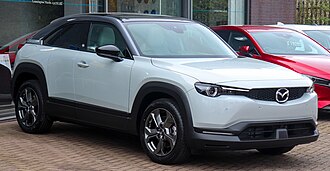
Mazda MX-30 as a Used Car: A Complete Buyer’s Guide
The Mazda MX-30 is one of the most unusual compact electric cars to appear on the European market in recent years. Rather than trying to compete directly with long-range electric SUVs, Mazda took a different approach: a relatively small battery, a distinctive interior, unconventional rear-hinged rear doors and a strong emphasis on design and driving character. The result is a car that makes much more sense for some used-car buyers than others. If you need an inexpensive electric vehicle for commuting, shopping and daily urban driving, the MX-30 can be an intriguing second-hand bargain. If you regularly travel long distances, however, its limited battery range is likely to become its biggest weakness.
Mazda launched the MX-30 as its first mass-production battery-electric vehicle in 2020. The European model uses a 35.5 kWh lithium-ion battery and a 107 kW (145 PS) electric motor, with an official WLTP combined range of around 200 km. Mazda subsequently introduced the MX-30 e-Skyactiv R-EV, a plug-in hybrid version that combines a much smaller 17.8 kWh battery with an 830 cc single-rotor Wankel engine that acts as a generator rather than mechanically driving the wheels. Mazda describes this as a unique plug-in hybrid approach, and it gives the R-EV an electric range of around 85 km before the rotary range extender becomes relevant.
That makes the MX-30 particularly interesting on the used market because there are effectively two very different cars carrying the same name. The pure EV is simple, quiet and ideal for relatively predictable daily journeys, while the R-EV is considerably more versatile for longer trips but also mechanically more complicated. Choosing between them is therefore the first major decision a prospective buyer needs to make.
What Makes the Mazda MX-30 Different?
A compact electric crossover with its own personality
The MX-30 does not look like Mazda simply took an existing petrol crossover and replaced its engine with an electric motor. Its proportions, interior design and unusual door arrangement were developed around a distinctive concept. The rear doors are hinged at the back, often called freestyle or suicide-style doors, and can only be opened after the front doors have been opened. This creates a large opening for passengers and makes access to the rear seats easier in some situations, although it is less convenient in tight parking spaces.
The cabin is arguably the MX-30’s most memorable feature. Mazda used a combination of conventional materials and more environmentally conscious alternatives, including cork and recycled materials, to create an interior that feels different from the increasingly screen-heavy cabins of many newer EVs. The dashboard is relatively restrained, and the car retains physical controls for many functions. For a used buyer, this gives the MX-30 an appealing sense of individuality.
The styling also means that the car has aged reasonably well. Early MX-30s still look distinctive rather than obviously dated, which is an advantage when considering a used EV that may already be several years old.
The biggest compromise: range
The MX-30’s greatest weakness is also the feature that defines it: the battery is small. Mazda’s European specification gives the battery a total capacity of 35.5 kWh and a WLTP combined range of approximately 200 km, with a quoted urban figure of up to 265 km under the applicable test procedure. Mazda also quotes energy consumption of around 19 kWh/100 km.
Those figures were modest even when the MX-30 was new, and they become particularly important when considering a used example. A battery-electric car with a 400- or 500-km official range can tolerate some degradation without fundamentally changing the owner’s routine. With an MX-30, every kilometre of lost range matters more because the original range was already relatively limited.
In real-world driving, owners should expect the usable range to depend heavily on temperature, speed, heating or air-conditioning use, terrain and driving style. A motorway journey in winter can reduce the available range dramatically compared with gentle urban driving in mild weather. This is not a defect unique to the MX-30, but its small battery makes the effect much more noticeable.
Mazda MX-30 EV: What Is It Like to Own?
Ideal for short and predictable journeys
The pure-electric MX-30 makes the most sense when your daily driving pattern is predictable. If you commute 30–70 km per day, have access to home charging and occasionally make longer trips using public chargers, the limited range may not be a serious problem. In fact, the small battery can be an advantage because there is less battery mass to carry around and charging at home can easily cover normal daily use.
For city driving, the MX-30 is particularly pleasant. Electric torque is available immediately, the cabin is quiet and the compact dimensions make it easy to manoeuvre. The electric motor produces 107 kW (145 PS) and 265 Nm, while Mazda quotes 0–100 km/h in 9.7 seconds and a top speed of 140 km/h.
It is therefore not a performance EV, but it does not need to be. The powertrain is smooth and responsive enough for normal traffic, and the car’s relatively relaxed character suits everyday urban use.
Charging is adequate rather than exceptional
The original European MX-30 supports AC charging and CCS DC fast charging. Mazda’s published figures give around 1 hour 50 minutes for a 20–80% AC charge using an 11 kW three-phase supply, while a 50 kW DC charger can take the battery from 20–80% in roughly 26 minutes under the stated conditions. Earlier technical documentation lists a maximum DC input of 50 kW.
Those figures are perfectly usable for a small-battery EV, but they are not spectacular by modern standards. The more important question for a used buyer is whether the car will spend most of its life charging at home. If you can plug in overnight, the relatively modest fast-charging capability becomes much less significant.
Before buying, inspect the charging cables and test both AC and DC charging if possible. Check that the charging flap operates correctly and that the car recognizes a charging connection without errors.
Buying a Used MX-30: Battery Health Matters Most
Don’t buy an EV based solely on mileage
Mileage is important on any used car, but with an EV it is only one part of the picture. Two MX-30s with similar odometer readings can have different battery conditions depending on climate, charging habits and previous use.
The battery is covered by a considerably longer warranty than the rest of the vehicle. Mazda’s published ownership information gives the high-voltage battery an eight-year/100,000-mile warranty, although exact terms and conditions depend on market and model year.
A battery-health report is therefore one of the most useful documents a prospective buyer can request. If one is not available, pay attention to the car’s estimated range at a known state of charge and compare it with what would normally be expected in similar weather and driving conditions. A professional EV battery diagnostic is even better.
Because the MX-30 began with a relatively small battery, a modest amount of degradation can have a disproportionate effect on its usefulness. A buyer who intends to keep the vehicle for many years should take battery condition particularly seriously.
Look at the charging history and usage
An MX-30 that spent most of its life charging slowly at home may be a more attractive proposition than one that depended heavily on public fast chargers, although charging history alone does not prove battery health. The important point is to establish how the vehicle was actually used.
Also check whether the car has been regularly left at very high or very low states of charge for extended periods. Modern battery management systems are designed to protect the battery, so buyers should not assume that every charging habit has caused damage, but a detailed history is still useful when assessing a used EV.
What About the Mazda MX-30 R-EV?
The unusual rotary range extender
The MX-30 R-EV is arguably the most fascinating version of the car. Instead of using a large battery, Mazda installed a 17.8 kWh battery and paired it with a single-rotor 830 cc Wankel engine. The rotary engine acts as a generator, supplying electricity to the system rather than mechanically driving the wheels. Mazda began European production of the R-EV in 2023, marking the company’s return to mass-production rotary-engine technology after the RX-8 ended production in 2012.
The system produces 170 PS (125 kW) and 260 Nm, with an official electric range of approximately 85 km. Mazda’s Czech-market technical data lists a 50-litre fuel tank, while the UK specification quotes a combined total range of more than 400 miles under its test conditions.
For the right owner, this makes considerably more sense than the pure EV. You can use electricity for most everyday journeys while retaining the ability to undertake longer trips without planning every charging stop. In effect, it offers the quietness and responsiveness of an EV for short journeys with the convenience of a combustion-powered range extender when required.
But the R-EV is more complicated
The advantage of the R-EV is also its main drawback. Instead of having only an electric motor and battery, you also have a rotary engine, fuel system, exhaust system and generator-related components. That does not automatically make the vehicle unreliable, but it means there are more components to maintain than in the pure EV.
A used R-EV therefore deserves a thorough inspection. Check that the petrol engine starts and operates correctly, that there are no warning lights, that the car switches between operating modes normally and that the charging system works as intended. The rotary engine is unusual enough that a specialist inspection can be particularly valuable.
For buyers who primarily drive short urban journeys and can charge at home, the pure EV remains simpler. For people who want an electric driving experience without giving up long-distance flexibility, the R-EV is arguably the more compelling MX-30.
Interior Space and Practicality
Comfortable for four, but not a family space champion
The MX-30 has five seats on paper, but its rear accommodation is not one of its major strengths. Mazda’s technical documentation gives rear legroom of approximately 861 mm, compared with 1,058 mm in front. The car’s overall length is 4,395 mm and its wheelbase is 2,655 mm.
Adults can use the rear seats, but taller passengers may find the space restrictive. The rear doors make access more interesting, but they do not magically create more legroom. The MX-30 is therefore better suited to couples, individuals and small families who use the rear seats occasionally rather than families carrying adults or teenagers on long journeys every day.
The boot is usable for everyday shopping and luggage, but buyers who regularly transport large items should test it with their own equipment. The sloping design and relatively compact dimensions mean that outright practicality is not the MX-30’s strongest selling point.
How Does the MX-30 Drive?
Driving dynamics are one of the reasons to consider an MX-30 despite its limited range. Mazda has always emphasized steering feel and chassis balance, and the MX-30 retains that philosophy. The electric motor delivers smooth acceleration, while the suspension and steering give the vehicle a more natural driving character than some heavier, comfort-oriented EVs.
The car is also relatively quiet. There is no conventional engine noise in the pure EV, making urban driving particularly relaxing. At higher speeds, tyre and wind noise become more noticeable, but overall refinement is good.
The R-EV changes the experience slightly because the rotary generator can start when the battery requires additional energy. It does not behave like a conventional hybrid where engine speed necessarily follows accelerator input in a direct mechanical relationship. For drivers accustomed to a traditional petrol engine, this can take some time to get used to.
Reliability and Common Used-Car Checks
The reliability picture
The MX-30 is still a relatively low-volume model, so there is less long-term reliability data than there is for Mazda’s mainstream petrol cars. What Car? notes that there were no specific problems to watch for beyond the usual used-car checks in its early used review, and it reported no recalls at the time of publication.
That said, later information has identified recalls affecting certain vehicles. Auto Express reports two UK campaigns: a very small 2020 campaign involving a potential airbag problem and a 2023 campaign involving an on-board-charger software issue that could cause the vehicle to think it was connected to a charger when it was not, potentially preventing it from moving.
This illustrates why a VIN-based recall check is essential. A recall does not automatically make a used car undesirable; the important question is whether the corrective work has been completed.
Check electronics and charging equipment
The MX-30 contains plenty of technology, so test everything. Check the infotainment display, cameras, parking sensors, climate control, heated seats, electric windows, central locking and driver-assistance systems. Make sure no unexplained warning lights remain illuminated after the car starts.
For the EV version, charging is especially important. Test the charging cable, charge-port locking mechanism and vehicle communication with the charger. If possible, perform an actual AC charge rather than simply plugging the cable in for a few seconds.
A pre-purchase inspection by someone familiar with electric vehicles is worthwhile, particularly if the seller cannot provide a recent battery-health report.
Running Costs of a Used Mazda MX-30
The MX-30’s running costs can be very attractive if you can charge cheaply at home. Electricity is generally less expensive per kilometre than petrol, and an EV has fewer conventional service items than an internal-combustion car. There is no engine oil, oil filter or traditional exhaust system to maintain on the pure EV.
Brake wear can also be relatively low because regenerative braking does much of the work when slowing down. Nevertheless, the car still requires normal checks of tyres, suspension, brakes, cooling systems and other components.
The R-EV is different. Because it contains a rotary engine and fuel system, it does not offer the same level of mechanical simplicity as the pure electric model. It can still be economical for owners who charge frequently, but maintenance should be approached more like that of a sophisticated plug-in hybrid than a conventional battery EV.
Who Should Buy a Used Mazda MX-30?
The ideal MX-30 buyer is someone who understands its limitations and sees them as irrelevant to their lifestyle. If you have a home charger, drive relatively predictable daily distances and rarely undertake long motorway journeys, the pure EV can be an excellent used-car proposition. Its compact size, distinctive appearance, comfortable cabin and quiet electric powertrain make it particularly well suited to urban and suburban life.
The R-EV is better suited to someone whose daily journeys are electric but who occasionally needs to travel much farther. Its rotary range extender removes much of the anxiety associated with the pure EV’s limited range, although the additional mechanical complexity and higher purchase price should be considered.
The MX-30 is less suitable for someone who regularly drives hundreds of kilometres in a day, lives without reliable access to charging or needs maximum passenger and luggage space. In those cases, a larger-range EV or conventional hybrid is likely to be a more practical choice.
Final Verdict: Is the Mazda MX-30 a Good Used Car?
The Mazda MX-30 can be a very good used car, but only if its limitations match your driving habits. Its small battery means it should not be compared with long-range electric SUVs on equal terms. Instead, it should be viewed as a stylish, compact EV designed around relatively short daily journeys.
The pure-electric model is the simpler choice and can be particularly attractive on the used market because its unusual range makes it less desirable to buyers who prioritize maximum kilometres per charge. That can translate into interesting second-hand prices. However, buyers must carefully assess battery health because the original 200-km WLTP range leaves less margin for degradation than a long-range EV.
The MX-30 R-EV is the more versatile alternative. Its 17.8 kWh battery provides around 85 km of official electric range, while the 830 cc rotary generator allows longer journeys without relying exclusively on public charging.
Ultimately, the MX-30 is not the obvious choice, and that is precisely why it can be appealing. It has distinctive styling, an unusual interior, genuinely enjoyable driving manners and technology that is different from most competing cars. If you understand that the pure EV is primarily a short-to-medium-distance vehicle, choose an example with healthy battery capacity, complete service records and completed recall work, and have the car professionally inspected before purchase, a used MX-30 can be an unusually interesting way into electric motoring.
Mazda MX-30 Technical Specifications
The following table summarizes representative European specifications. Figures vary slightly according to model year, market and equipment, so the exact specification of an individual used vehicle should always be verified from its VIN and original documentation. Mazda’s Czech technical data, for example, lists separate specifications for the EV and R-EV versions.
| Specification | MX-30 EV | MX-30 R-EV |
|---|---|---|
| Powertrain | Battery electric | Plug-in hybrid with rotary generator |
| Electric motor output | 107 kW / 145 PS | 125 kW / 170 PS |
| Maximum torque | 265 Nm | 260 Nm |
| Battery capacity | 35.5 kWh | 17.8 kWh |
| Battery type | Lithium-ion | Lithium-ion |
| Rotary engine | — | 830 cc, 1 rotor |
| Rotary engine output | — | 55 kW / 74 PS |
| Fuel tank | — | 50 litres |
| WLTP electric range | 200 km | 85 km |
| Official combined electricity consumption | 19 kWh/100 km | 17.5 kWh/100 km |
| Maximum speed | 140 km/h | 140 km/h |
| 0–100 km/h | 9.7 seconds | 9.1 seconds |
| Transmission | Single-speed automatic | Single-speed automatic |
| Drive | Front-wheel drive | Front-wheel drive |
| Length | 4,395 mm | Approximately 4,395 mm |
| Width | 1,795 mm | Approximately 1,795 mm |
| Height | 1,555 mm | Approximately 1,555 mm |
| Wheelbase | 2,655 mm | 2,655 mm |
| Seating | 5 | 5 |
| DC charging | Up to 50 kW | Up to 36 kW |
| Best suited to | Urban/suburban EV use | Electric daily driving + longer trips |
In summary, the Mazda MX-30 is a used car for a specific type of driver rather than a universal family-car recommendation. The pure EV works best as a second car or as a primary vehicle for someone with predictable daily mileage and convenient home charging. The R-EV is the more flexible choice for longer-distance drivers, while its unusual rotary range-extender technology gives it a character almost no other modern used car can match. For buyers willing to accept the MX-30’s limited practicality and range, it can be an appealing, distinctive and potentially excellent-value used vehicle.
